Category Archives: Radio history

1945 Four-Tube Portable Station

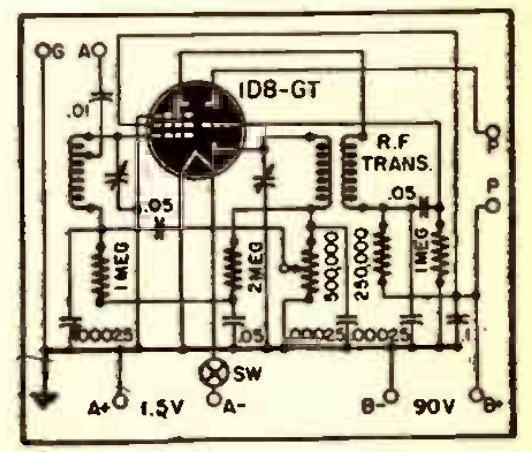
1945JanQST11945JanQSTEighty years ago, there was still a war going on, and hams were off the air for the duration. But more than a few of them were itching to get back on the air as soon as possible, and one of them was apparently Sheldon W. Gates, W8VWK, who designed this portable station, described in the January 1945 issue of QST.

The three-band (80, 40, and 20 meters) station was housed in a small vanity case which measured 11.5 by 6.5 by 7 inches, and which set him back $2.49. He originally considered designing the set for battery operation, but since he described himself as a city boy who rarely went farther than the power lines, he settled on AC power. The transmitter used a single 117N7 tube, and the receiver was a three-tube Meissner Student Midget Kit that he cut down to fit the available space. Since the receiver used 1 volt tubes, he included a dry cell to run those filaments.

The cover of the case included plenty of room for logbook, key, crystals, and headphones. At the end of the article, he reminded readers that the transmitter could not be operated on the air at the present time.


1950 Transistor Radio

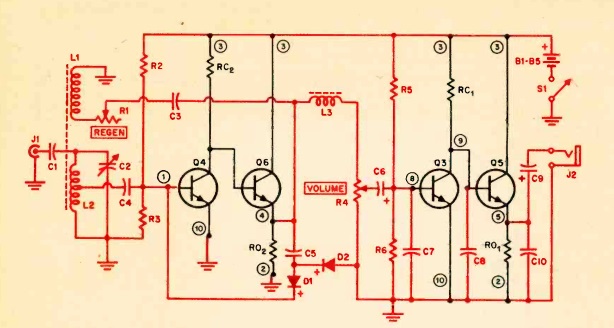
1950JanRadioNewsFor many radio hobbyists, this could very well have been the first transistor radio they had ever seen. The invention of the transistor was announced in 1948, and the first commercial example to hit the market was the Raytheon CK-703 later that year. The January 1950 issue of Radio News showed how to build this project, a crystal receiver, with three stages of audio amplification, courtesy of the new “crystal triodes.”1950JanRadioNews3

The new transistors resembled miniature tubes, and required sockets. The collectors and emitter terminals had pins, and the base connection was to the brass case of the device. Sockets had not yet hit the market, so the builder, Rufus Turner, K6AI (earlier W3LF), had to fabricate them himself.

He noted that the set would not drive a loudspeaker, but would “give a walloping good signal in high-impedance headphones.” He noted that “enterprising radio men undoubtedly will find a host of applications for this device.”

RufusTurnerTurner is said to be the first African-American licensed amateur radio operator. He had no formal education in electronics, but managed to achieve Professional Engineer status in two states. He was involved in the development of the 1N34 diode with Sylvania. When he did go to college in the late 1950s, he received his degrees in English and became a professor of English at California State College, although he continued to publish in electronics.

1950JanRadioNews2


1925 Paragon Radios

1925JanRadioRetailingOne hundred years ago this month, this couple were enjoying some dance music courtesty of their Paragon receiver. In this ad in the January 1925 issue of Radio Retailing, the manufacturer, Adams Morgan Co., 14 Alvin Ave., Upper Montclair, NJ, reminded retailers that if they were not featuring Paragon, they were missing out on profit opportunities.


Six Meter Mobile, 1965

1965Jan73Shown here, at the reins, is 73 Magazine publisher Wayne Green, operating some six-meter mobile. Seated next to him, in the raccoon coat, is Bob Cushman of Cushcraft, the maker of the Squalo antenna. Pulling the duo is Arabian stallion Alrun, said to be the pride of 73 farms.

The photo, taken by K2YDD, appeared on the cover of 73 Magazine, January 1965.


Some links on this site are affiliate links, meaning that this site earns a small commission if you make a purchase after using the link.

First Radio Innaguration: 1925

Inauguration day 2025 marks a hundred years of the broadcast of presidential inaugurations. In 1925, the inauguration still took place on March 4 (the change to January 20 came in 1947), but on that day, an estimated 22 million Americans tuned in to hear Calvin “Silent Cal” Coolidge be sworn in and address the nation.

Among the listeners were millions of schoolchildren, whose classrooms had recently been equipped with radio receivers.

1925Mar5WashStarThe broadcast also marked the first time that an address by the President was broadcast in a foreign country. WBZ Boston carried the broadcast with a telephone connection to Washington. Its signal was in turn picked up by CKAC in Montreal, which broadcast the entire proceeding. The fact is noted in this clipping from the Washington Evening Star, March 5, 1925.

Of course, loyal readers will remember that Charles Dawes, the first Native American to hold the office of Vice President, and the first Vice President to write a Top 40 song, was also sworn in that day.


Bringing the Car Radio Inside, 1945

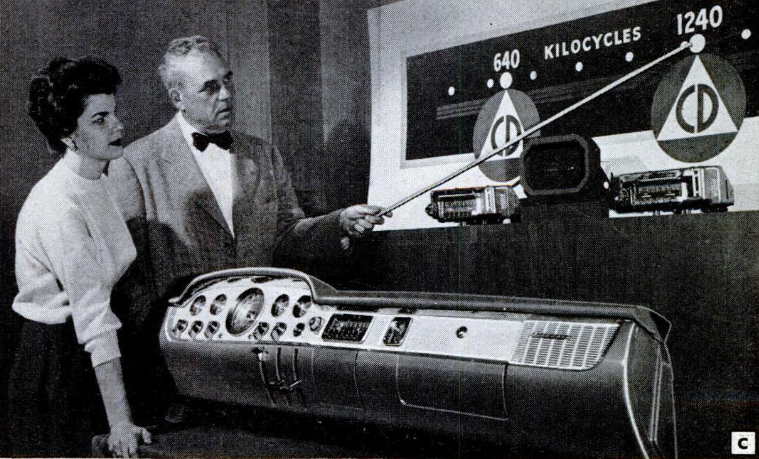
1945JanPSOne recurring theme during World War II was converting a car radio to operate indoors. This was because there was a shortage of receivers, due to production being stopped. And with gas and tire rationing, the car radio wasn’t getting much use. So it was only logical to bring it inside, and that’s what this gentleman was doing, following some pointers found in Popular Science for January 1945, eighty years ago this month.

The article discussed such things as replacing the speaker, since the car radio probably employed a 6-volt field coil, and it was easier to get a permanent magnet speaker. And, of course, a bit of rewiring would be necessary to get it to run off household current. The antenna was the easy part, since the car radio required only a short piece of wire.


10 and 20 Minute Blocks for Radio? 1945

1945Jan16BCEighty years ago, the January 16, 1945, issue of Broadcasting put forth this idea that apparently never went anywhere.  Suggested by one Joseph R. Spadea, the idea was that instead of carving up radio time into blocks of 15 or 30 minutes, blocks of 10 and 20 minutes could instead be used.  The author noted that some 30 minute programs seemed to drag on a bit too much, and this could tighten things up.


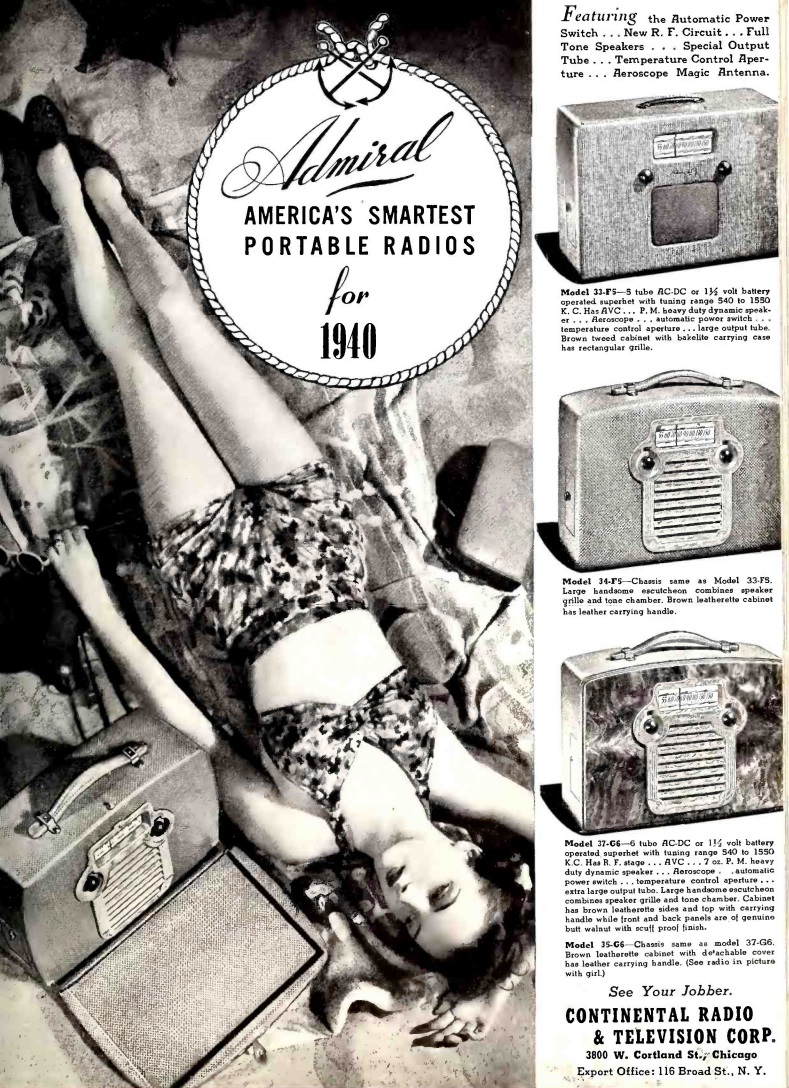
1940 Admiral Radios

1940RadioRetailingJan1940 was one of those times when people dressed up to listen to the radio, especially if the radio came from Admiral. This two-page spread from the January 1940 issue of Radio Retailing
shows that company’s offerings in table radios, including both broadcast sets, and also two-band sets covering the short waves.

Broadcast sets started for only $9.95, and a shortwave set would set you back only $12.95. Most sets offer “television sound,” meaning only that they had an audio input jack on the back that could supposedly be hooked to a future television. All of the sets tuned up to 1730 kHz on the AM dial, meaning that they could pick up many police calls.

Shown in the ad are Admiral models 13-C5, 14-C5, 20-A6, 21-A6, 22A-6, 23-A6, 15-B5, 17-B5, 18-B5, 396-6M, 397-6M, 398-6M, 399-6M, and 25-Q5.


1955 Test Instruments

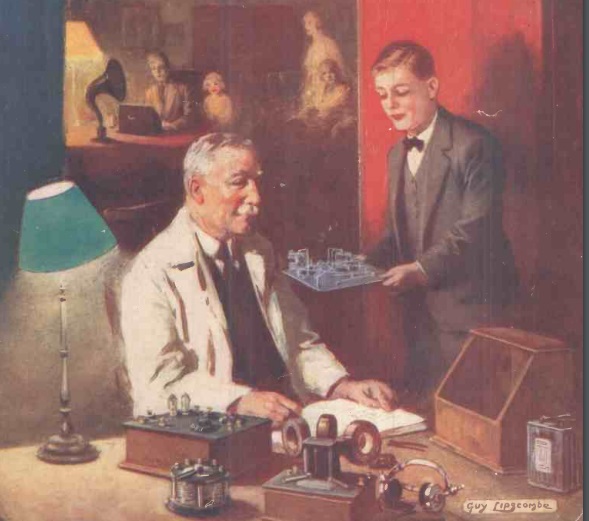
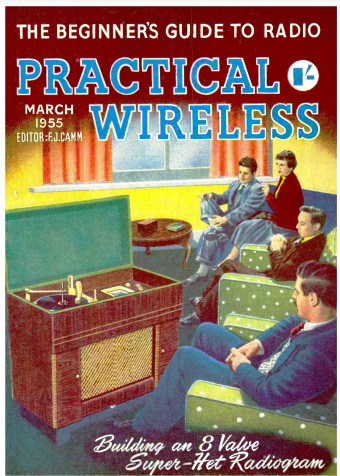
1955JanPracWirWe don’t know exactly what this gentleman is working on, but it’s safe to say that he’s making use of his electronic test instruments. But one thing is for sure–if you’re a proper British gentleman, you put on a tie before getting to work in your electronic workshop.

This illustration appeared 70 years ago this month on the cover of the January 1955 issue of Practical Wireless.


Harry Truman’s Hallicrafters

471426799_10235578391664196_798128690280920462_n

We recently had the privilege of visiting the Harry S Truman Library and Museum in Independence, MO., which included this recreation of the White House Oval Office as it appeared during President Truman’s time in office.  Most of the objects in the room, such as the artwork, were the originals.

If you’re reading this as it’s posted, you’re probably aware that the Kansas City area is completely snowed in by a blizzard, which was preceded by freezing rain. The museum closed early in anticipation, and will remain closed through Monday, January 6. We were aware the storm was coming, but were confident that we would be out of the area in time, and we were indeed. We hit the Iowa state line about an hour before the museum closed.  We had severe clear conditions all the way home, and the only sign of winter was the cold.  But about the same time, Interstate 35 was closed near Kansas City because of a crash caused by the ice.   Had we waited a few more hours to leave, we would still be there.

472504283_10235578380583919_3925131071453832686_nOf course, for most readers of this site, upon seeing the photo at the top, your eyes were immediately drawn to the object directly behind the desk.  And, of course, it’s the first thing we noticed.  It is a Hallicrafters SX-28 “Super Skyrider”.  The 15-tube set covered 550 kHz through 44 MHz, and was a top-of-the line receiver, as would be expected from a set in such a place of honor.

If I were the Leader of the Free World, I would also want to have a shortwave receiver at my desk.  And when Truman met at the White House with former President Herbert Hoover, we have little doubt that Hoover approved of the inclusion of this useful device.  But I’ve been unable to find much reference to it.  I would like to know how often Truman had it turned on, his thought process in getting it, and how exactly he used it.  Unfortunately, because of the weather, I didn’t have time to ask the library staff.

The library website shows that there is a file pertaining to Hallicrafters in Truman’s personal files.  If I had more time, I would have gone over to the reading room to look at this file, but it classification indicates that the receiver was Truman’s personal property, as opposed to government property.  The next time I’m in Kansas City, I’ll probably make an appointment to view that file.  In the meantime, if any of our readers would be interested in inspecting that file, please let us know.

I did find this thread at QRZ.com where W6OGC had written to the museum asking about the receiver.  This is the reply he received:

Recently you asked about the short wave radio that is displayed behind President Truman’s desk in the Library’s replica of the Oval Office.

This is a Hallicrafters SX-28 “Super Skyrider” short wave radio receiver, along with its speaker, a Hallicrafters model PM-23. These units are not the actual short wave sets used in the Oval Office, but they are units the Truman Library purchased in 1995 to closely duplicate those that were in the Oval Office when President Truman occupied it.

Photographic evidence of President Truman’s Oval Office as it appeared in the summer of 1950 indicates that there was a Hallicrafters receiver behind his desk, the left side of which resembled a Hallicrafters SX-28 and the right half of which resembled a Hallicrafters SX-32 (a later model). According to Mr. Chuck Dachis of The Hallicrafters Collector of Austin, Texas, the model that was actually in President Truman’s office was probably made during a transition period (1940-1943) between the production of the models SX-28 and SX-32. This seems to suggest that the receiver may have been first acquired during the administration of Franklin D. Roosevelt and simply remained in the White House during the Truman years.

We do not know, with any degree of certainty, just how the receiver was utilized during the Truman Presidency, although it is entirely possible that Truman used it at the end of the Second World War to listen to war broadcasts from various locations.

I hope this information will be of assistance to you. Thank you for your inquiry and for your interest in the Harry S. Truman Library.

Clay Bauske
Museum Curator
Harry S. Truman Library

472347243_10235578388664121_8660988157925256905_nIf the Hallicrafters wasn’t the first thing you saw in the photo, the only other explanation is that your eyes were fixed on the television set.  Truman was the first president to have a television in the office, and this one appears to be a DuMont model RA-108 from 1949.  Of course, it stands to reason that Truman was the first president to have a TV in the White House.  The first station to come on the air in Washington, W3XWT, later WTTG, came on the air in May, 1945, a month after Truman took office.  According to the Winter 1949 issue of White’s Radio Log, there were four stations on the air in Washington when this set rolled off the assembly line.

While we were at the Library, we took the opportunity to sign the condolence book for President Jimmy Carter, shown here in this earlier Library photo.  The book will be sent to the Carter Library  in Atlanta.


L