Category Archives: Radio history

Transatlantic Portable Contact, 1925

As most readers of this site already know, one of my interests in amateur radio is portable operating, through activities such as Field Day, Parks on the Air, and World Wide Flora and Fauna. It’s fun to go to just about any spot on earth, and know that within a short time, I can be sending signals around the world. While most of my contacts wind up being domestic, there is always still a bit of a thrill when my signal hops the Pond.

And that excitement is nothing new, as shown by this ad in Popular Wireless a hundred years ago today, August 8, 1925. It recounts the recent field gathering of the Golders Green and Hendon Radio Society (assisted by the Hounslow and Inland Revenue Radio Societes) at which communications with the United States was first effected using portable apparatus.

To make this happen, the valves (what Americans would call vacuum tubes) bore the Marconi and Osram brand.

You can read more about this historic contact in the New York Times for June 8, 1925.


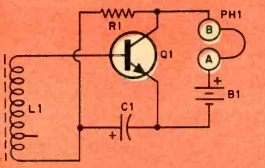
1965 3 Transistor Regen

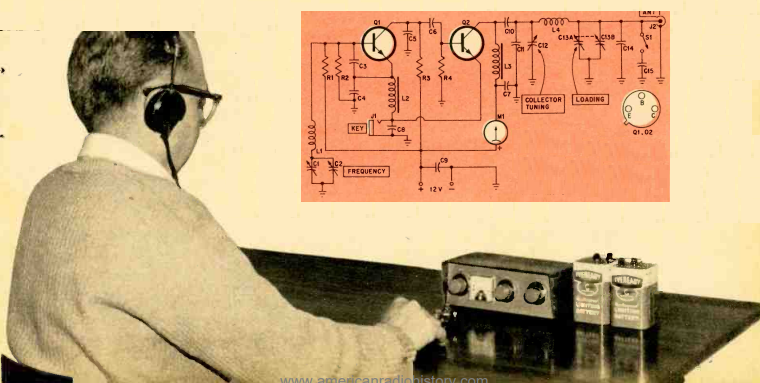
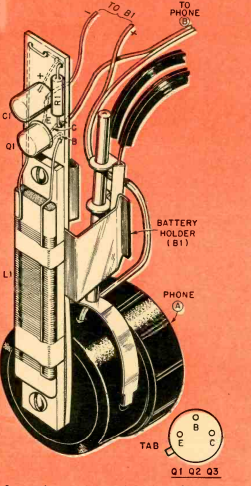
Sixty years ago this month, the August 1965 issue of Radio-TV Experimenter carried the plans for this three-transistor shortwave regenerative receiver. The parts would set you back only $14, and the completed set was said to be the size of a QSL card.  As shown here, it covered 4-15 MHz, although it could be modified to cover any range between 500 kHz and 30 MHz.  Even a beginner could have it together in about 8 hours.

The set called for a 50 foot antenna and high impedance headphones, although on strong signals, a speaker could be used, in conjunction with a matching transformer.


1940 “Tom Thumb” Portable

If you were looking for a portable radio 85 years ago, you could get this one for $9.95, as seen in this ad in the August 3, 1940, issue of the Tacoma (Washington) Times. The set was billed simply at the “Tom Thumb,” and I haven’t been able to track down the manufacturer.

But the main selling point was that the “A” battery was a normal flashlight battery, which could be replaced for a dime. Of course, there was also the B battery (of perhaps 45 or 90 volts) which would have been more expensive. But in fairness, the A battery would run down faster, and when it did, you could get one at any gas station or drug store.

You could get the radio at the Weisfield & Goldberg jewelry store, and if you credit was goo, it was only 85 cents a month.


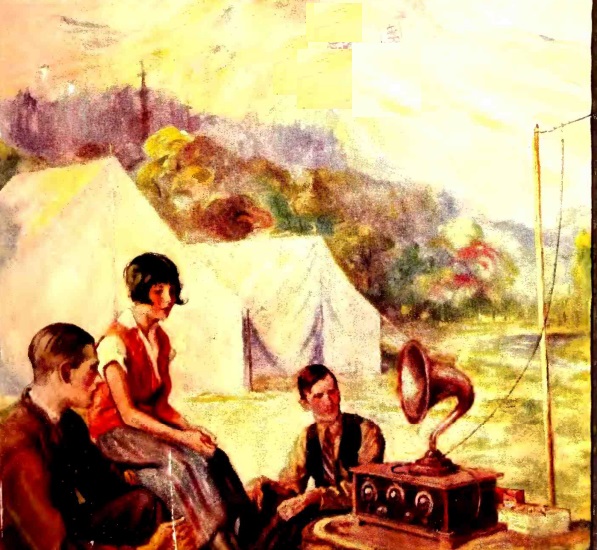
Radio to the Rescue: 1955

Seventy years ago this month, the August 1955 issue of Popular Electronics didn’t contain any articles specifically related to this cover illustration. But the painting was just to good not to use. All we know for sure that the painter was Ed Valigursky. The gentleman with the radio was probably a ham, and probably using six meters. He undoubtedly saved the town by directing the other gentleman to add a few more sandbags at this critical spot.


1940 Radio Batteries

If you were a radio dealer 85 years ago, you wanted to be the one on the left, and not the one on the right. But it wasn’t quite that simple, as discussed in the August 1940 issue of Service magazine.

There was a wide variety of non-standard batteries for radios, and if a dealer stocked them all, there would be the problem of selling stale ones when the customer for one of the rare ones came in. So first of all, when selling new portables, you would keep your customers satisfied in the long run by selling only sets using standard batteries. In some cases, it was an underhanded trick by the manufacturer–they would design the set so that only their proprietary batteries would fit (not unlike printer manufacturers today, who make their profits from selling ink cartridges, a practice which can be beat by taking the advice on our website).

Customers were often reluctant to have you permanently change the wiring of their set to add a plug that would fit standard batteries. A good solution was often to sell them an adapter. Some were available off the shelf. In other cases, you could make an adapter by removing the socket from the old battery and connecting it to a standard plug.


1950 Code Oscillator

Seventy-five years ago, many would-be hams were applying themselves to learning the code, and the July 1950 issue of Radio-Electronics obliged them by providing the plans for this simple code practice oscillator. The circuit is simplicity itself, and is built in to a jam tin, complete with speaker. The 6-volt tube ran fine on 4.5 volts from three flashlight cells, and the circuit required no additional B+ voltage.

It featured adjustable pitch, and put out a clear tone through either loudspeaker or headphones.


A Rare Species: 1925

One hundred years ago, it was the rare breed who did not have a radio set. And that was true on both sides of the Atlantic, as demonstrated by this cartoon in the July 1925 issue of Wireless Constructor.

Under pressure, this man had to admit that he didn’t own a wireless set. As the caption notes, we also wonder what he lived for.


1945 Radio Listings

Here’s what was on the radio 80 years ago, from the radio listing in the July 25, 1945, issue of the Washington Evening Times. You can click on the image above for a larger version.


Kimbark Electric, Chicago, 1945

Eighty years ago, there was still a war going on, but people were itching for things to get back to normal. For example, civilian radios were still out of production, but this dealer guessed (correctly, it turns out) that there would be new ones rolling off the assembly line come fall. The picture appears on the cover of the July 1945 issue of Radio Service Dealer, and that issue gives no clues as to exactly where the sign is located.

But with a little bit of detective work, we found the location, and we also determined that the picture shown above was Photoshopped! The sign above reads “This Fall! New Radios.” The magazine doesn’t say where the sign is located. The magazine states only “dealer looks forward.”

But the identical photo appeared in the December 1943 issue of the magazine.  Well, we should say that it was almost identical.  Because the sign really said, “Wanted-Used Radios.”  I bet they still wanted them in 1945, but a graphic artist (if not the dealer) guessed that the end of the shortage was in sight.

The 1943 issue reveals that the shop was Kimbark Electric Appliance Co., 1309 E. 53rd St., Chicago.  The owner was Harold E. Wollenhaupt, who died in 1989.


1925 Portable Radios

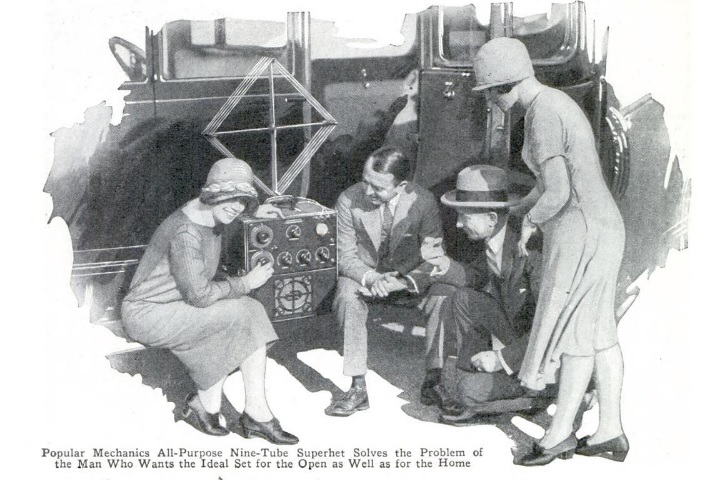
A hundred years ago, the July 1925 issue of Talking Machine World carried this ad from RCA showing Radiola models 24 and 26.  These models had performance on par with modern receivers, as they were superheterodynes containing six UV-199 tubes.

Millions of Americans were heading for sea and mountains, and this ad reminded dealers that they were all prospects for a set such as this, if only the dealer took time to sell them on the idea.

They weren’t cheap, however.   They started at $195, which works out to over $3600 in 2025 dollars.  Today, for a tiny fraction of that price, you can get an inexpensive portable which will pull in AM, FM, and weather broadcasts.  (And, of course, don’t forget to buy some extra batteries, which we guarantee will weigh a lot less than the ones this gentleman is using.)


Some links on this site are affiliate links, meaning that this site earns a small commission if you make a purchase after using the link.