Category Archives: Iowa History

Distance Education for Disabled Students, 1941

1946JuneService

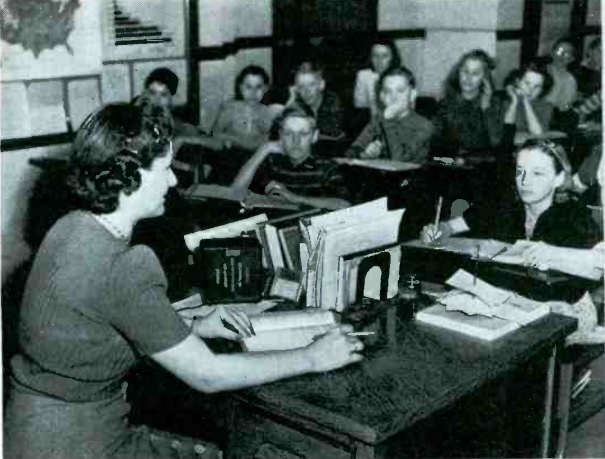
Shown here is Mary Ellen Lydon, a teacher at Monroe Junior High School in Mason City, Iowa, instructing her class 75 years ago. In addition to teaching the students in the classroom, you will notice an intercom sitting on her desk. With this device, she was able to bring instruction to shut-in students at home, as described in the June 1941 issue of Service magazine.
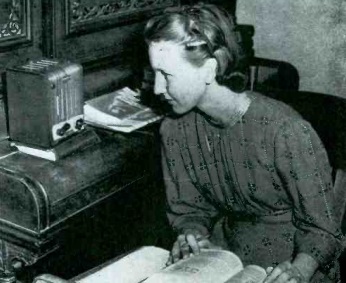
Mason City student Mary Brown receiving her instruction at home.

Mason City student Mary Brown receiving her instruction at home.

The article reported on the experiences of fifteen rural Iowa school districts which, mindful of their responsibility to furnish education to physically handicapped children, relied upon this method. The program began in Newton, Iowa, in 1939, when the school was unable to provide teaching facilities to a disabled student. The experiment proved a success. In particular, there was such a benefit to her morale and physical condition that she was able to return to school before the end of the semester, despite an earlier prognosis that she would be disabled for an entire year. In many cases, the shut-in students excelled academically, and in one cases, the shut-in was elected class president.  In total, over a hundred sets were in use in Iowa classrooms.

The equipment consisted of standard commerical intercoms, along with transformers to allow their use over standard leased telephone lines. At school, as the students went from class to class, the intercom was brought to the next teacher’s room to allow the student to attend the full schedule of classes.  The cost of equipment was about $40 per pupil served, and the phone lines were leased at a monthly rate of $1.25 for the first quarter mile, and 75 cents per each additional quarter mile. The longest distance served was about five miles.

Click Here For Today’s Ripley’s Believe It Or Not Cartoon


9KT, St. Anthony, Iowa, 1916

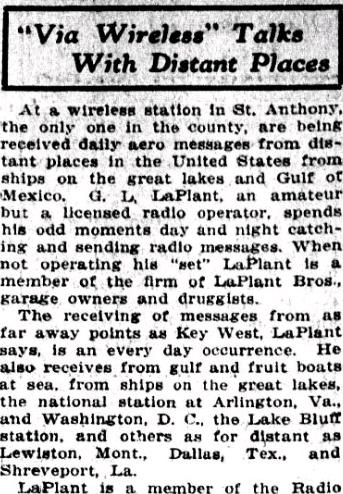
1916Mar28A century ago today, the novelty of having received a wireless message from an amateur radio operator prompted an Iowa newspaper editor to investigate. The following item appeared in the Marshalltown Evening Times-Republican, March 28, 1916.

“Via Wireless” Talks With Distant Places

At a wireless station In St. Anthony, the only one In the county, are being received dally aero messages from distant places In the United States from ships on the great lakes and Gulf of Mexico. G. L. LaPlant, an amateur but a licensed radio operator, spends his odd moments day and night catching and sending radio messages. When not operating his “set” LaPlant is a member of the firm of LaPlant Bros., garage owners and druggists.

The receiving of messages from as far away points as Key West, LaPlant says, is an every day occurrence. He also receives from gulf and fruit boats at sea. from shlps on the great lakes, the national station at Arlington, Va., and Washington, D. C., the Lake Bluff station, and others as for distant as Lewlston, Mont., Dallas, Tex., and Shreveport, La. LaPlant is a member of the Radio League of America, whose members promise to give thetr services as radio operators or their station to the government whenever the government wants either.

A good roads wireless telegram, sent out to all commercial clubs In Iowa by Charles Van Vlecli, of the Waterloo Commercial Club, was received here this morning, having been relayed by mail from the St. Anthony wireless station.

The message was sent out Saturday night and reads:

“There Is a general demand for good roads in Iowa now, so pull her out of the mud this year.”

The message Was started at Waterloo at 11 o’clock Saturday night, and reached St. Anthony at ll:ll. St. Anthony station Is 9KT and Waterloo is 9QF in the Amateur Wireless Association. The messages were sent under the auspices of the Hawkeye Radio Association.

Mr. LaPlant has offered to send a message from here to any part of the state, if arrangements can be made. He suggests that the Y. M. C. A. of this city should install a set for the entertainment as well as instruction of young men who would be Interested.

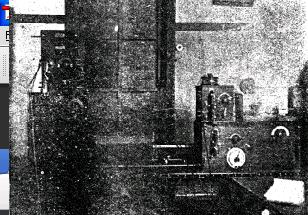
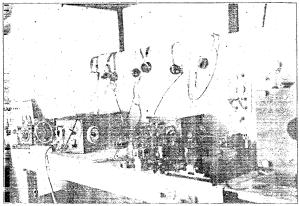
9kt1916As the article notes, LaPlant’s call sign was 9KT.  According to the 1915 Call Book, his station put out a respectable 990 watt signal from St. Anthony.  The photo of the station shown here appeared in the April 1916 issue of QST.  This illustration shows the receiving station, and the caption notes that since the picture was taken, and RJ8 audion and an ultraudion hook-up had been added.  The transmitting station, not shown, is described as “well-equipped.”

The station was shown again in QST the next year, in the April 1917 issue, with the photo shown below.  The caption notes that “we have been able to follow the improvement of his set and now it has reached a very high state of development.”

9kt1917
Click Here For Today’s Ripley’s Believe It Or Not Cartoon


Amateur Station 9CXX, 1925

9cxx1925

Ninety years ago this month, in an article entitled “Riding the Shortwaves,” Radio Age (November 1925) carried this photo of the efficient, but surprisingly simple, amateur station of 16 year old 9CXX, located at 514 Fairview Drive, Cedar Rapids, Iowa.  The article was an introduction to amateur radio, and pointed out that stations such as the one shown here could pull in stations from around the world with a three-tube receiver, “while broadcast listeners are using receivers with five to nine tubes.”

The article focused on the station of young 9CXX because in the summer of 1925, the then-15-year-old amateur had come to prominence by being the only station who managed to keep in touch with WNP, the station of the MacMillan Arctic expedition aboard the Bowdoin.

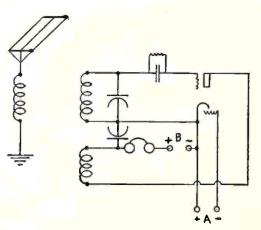
9cxxRxA schematic of the 9CXX receiver is shown here.  It was also followed by two stages of audio amplification, which are not shown.  As can be seen, the circuit is very simple.  While the receiver is regenerative, it has no regeneration control.  Instead, the regeneration was adjusted by reaching in and carefully moving the two coils.  And in order to avoid capacity effects, the tuning condenser (which had to be of the highest quality, according to the article) had no type of vernier dial.  Instead, the shaft had an eraser mounted at the end which was used to carefully tune the set.  With the two stages of audio, it was reported that the Arctic expedition had come in loud and clear to the point that the operator could remove the headphones and hear the voices of the crew throughout the room.

9cxxTx

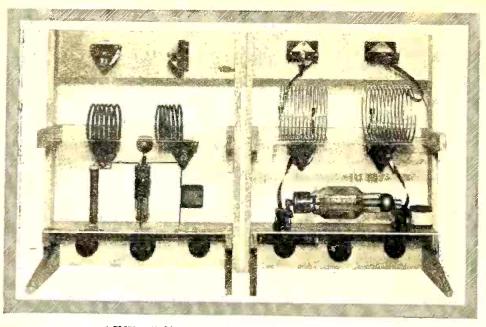
9CXX had two transmitters, shown here.  The one on the right put out 50 watts, and the one on the left 1000 watts.  The high power transmitter used 4000 volts on the plate.  When the power supply caused the house lights to dim, the 15 year old installed a new 20 amp circuit, running a heavy cable up from the house’s service box.  The contacts with the Arctic were made on 15, 16, and 21 meters.  He routinely made contact with Australia, usually on 40 meters.

When the young ham made his contacts with the Arctic, it was with antennas installed in a tree.  “Having built a dream house, on Colonial lines, his parents were thinking more of architectural beauty than of scientific achievement, and poles are likely to be unsightly.  But since their son established his remarkable record there have been erected on the roof two thirty-foot masts.”

If the call sign looks vaguely familiar, that’s because it was held by someone who went on to continued prominence in radio, Arthur A. “Art” Collins, who later held the calls W9CXX and W0CXX.  Collins built is first radio, a crystal set using a Quaker Oats box, at age 9.  By 1923, after attending a two-day radio course at Iowa State University in Ames, he had his amateur license.  In 1931, then married, he decided to turn his hobby into a business and started Collins Radio in his basement at 1620 Sixth Ave. S.E., Cedar Rapids.

He formally incorporated the company in 1933, and by 1954, the company, now Rockwell-Collins, had sales of $80 million. The company remained a leading producer of broadcast transmitters until the 1970’s, and also produced amateur equipment most of that time.  Along with fellow  amateur General Curtis LeMay, Collins played a large role in the adoption of SSB voice by the U.S. military.

A good biography of Art Collins can be found at WA3KEY’s site.

Read More at Amazon

Click Here For Today’s Ripley’s Believe It Or Not Cartoon


WOI, Ames, Iowa, 1925

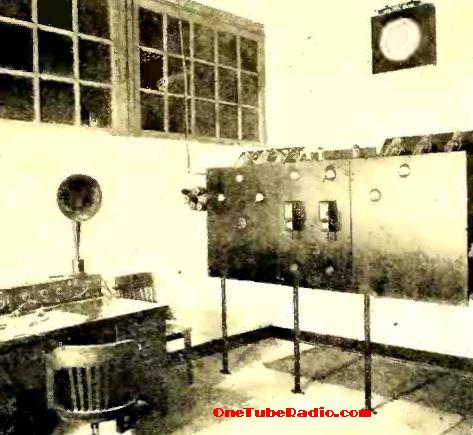
WOI operating room, 1925.

WOI operating room, 1925.

Ninety years ago, the September 1925 issue of Radio Age carried a profile of radio station WOI, at Iowa State College (now Iowa State University) in Ames, Iowa. In 1925, the station’s focus was clearly on the farmer, and the article notes that the station was “maintained for the farmer by men who have practical farm experience.” The station began operating as WOI in May 1922. Programming included market reports, seasonal lectures of interest to farmers, and weather reports. Entertainment programs included both classical and popular music.

Even prior to the station being licensed as WOI, Iowa State College was a hotbed of radio activity. Even before World War I, weather reports had been broadcast by station 9YI, the predecessor of W0YI, the University’s Amateur Radio club station.

The article notes that the college offered an annual course in radio construction “which has enabled the farmer and especially the boys and girls on the farm to build their own sets.” At one such course, held annually in April, more than 500, from Iowa, Minnesota, Illinois, and Nebraska, descended on the campus to take part in the free course. In addition to the construction of broadcast sets, there was instruction in Amateur Radio, offered by students connected with Amateur station 9LC.

The station then operated on 270 meters (1111 kHz) with a power of 500 watts. The antenna consisted of wire aerials connected to a water tank and massive smoke stack 150 yards apart.

WOI is currently the flagship station of the Iowa Public Radio network. It’s 640 kHz signal (5000 watts daytime, 1000 watts nighttime) covers most of the state of Iowa during daylight hours, as well as good portions of adjoining states.

Click Here For Today’s Ripley’s Believe It Or Not Cartoon