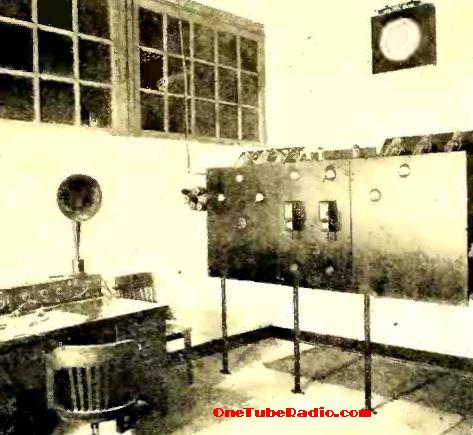
Ninety years ago this month, in an article entitled “Riding the Shortwaves,” Radio Age (November 1925) carried this photo of the efficient, but surprisingly simple, amateur station of 16 year old 9CXX, located at 514 Fairview Drive, Cedar Rapids, Iowa. The article was an introduction to amateur radio, and pointed out that stations such as the one shown here could pull in stations from around the world with a three-tube receiver, “while broadcast listeners are using receivers with five to nine tubes.”
The article focused on the station of young 9CXX because in the summer of 1925, the then-15-year-old amateur had come to prominence by being the only station who managed to keep in touch with WNP, the station of the MacMillan Arctic expedition aboard the Bowdoin.
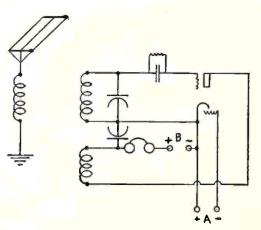 A schematic of the 9CXX receiver is shown here. It was also followed by two stages of audio amplification, which are not shown. As can be seen, the circuit is very simple. While the receiver is regenerative, it has no regeneration control. Instead, the regeneration was adjusted by reaching in and carefully moving the two coils. And in order to avoid capacity effects, the tuning condenser (which had to be of the highest quality, according to the article) had no type of vernier dial. Instead, the shaft had an eraser mounted at the end which was used to carefully tune the set. With the two stages of audio, it was reported that the Arctic expedition had come in loud and clear to the point that the operator could remove the headphones and hear the voices of the crew throughout the room.
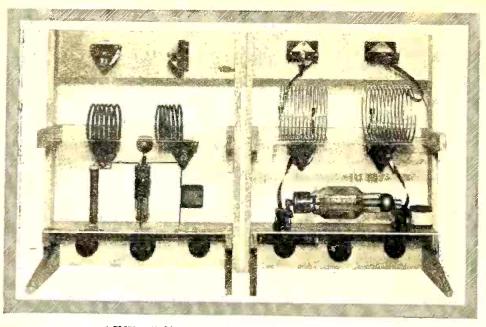
9CXX had two transmitters, shown here. The one on the right put out 50 watts, and the one on the left 1000 watts. The high power transmitter used 4000 volts on the plate. When the power supply caused the house lights to dim, the 15 year old installed a new 20 amp circuit, running a heavy cable up from the house’s service box. The contacts with the Arctic were made on 15, 16, and 21 meters. He routinely made contact with Australia, usually on 40 meters.
When the young ham made his contacts with the Arctic, it was with antennas installed in a tree. “Having built a dream house, on Colonial lines, his parents were thinking more of architectural beauty than of scientific achievement, and poles are likely to be unsightly. But since their son established his remarkable record there have been erected on the roof two thirty-foot masts.”
If the call sign looks vaguely familiar, that’s because it was held by someone who went on to continued prominence in radio, Arthur A. “Art” Collins, who later held the calls W9CXX and W0CXX. Collins built is first radio, a crystal set using a Quaker Oats box, at age 9. By 1923, after attending a two-day radio course at Iowa State University in Ames, he had his amateur license. In 1931, then married, he decided to turn his hobby into a business and started Collins Radio in his basement at 1620 Sixth Ave. S.E., Cedar Rapids.
He formally incorporated the company in 1933, and by 1954, the company, now Rockwell-Collins, had sales of $80 million. The company remained a leading producer of broadcast transmitters until the 1970’s, and also produced amateur equipment most of that time. Along with fellow amateur General Curtis LeMay, Collins played a large role in the adoption of SSB voice by the U.S. military.
A good biography of Art Collins can be found at WA3KEY’s site.
Read More at Amazon
Click Here For Today’s Ripley’s Believe It Or Not Cartoon