Category Archives: Camping

1923 Camping Afloat

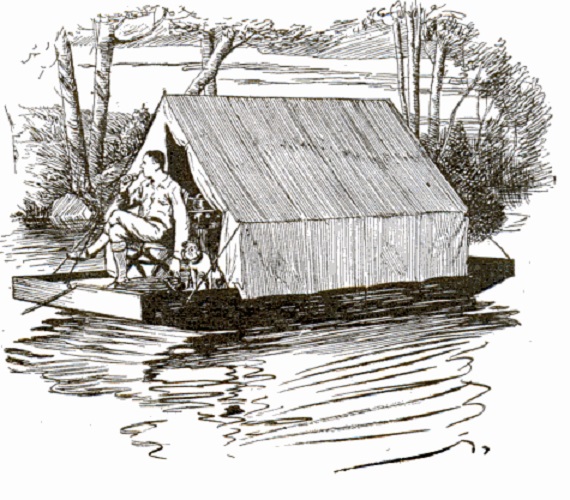
1923AugPM3A hundred years ago, “the newest way of camping is to pitch a tent on a barge,” and the August 1923 issue of Popular Mechanics showed you just how to do it. The construction article, penned by “widely known authority on outdoor life” Stillman Taylor, notes that the floating camp has many unique advantages. It was easy to build and not expensive, and provided a good comfortable canvas home with large storage places. And whenever the camper felt like picking up and changing camp, he could easily drift with the current and wind to a new spot.

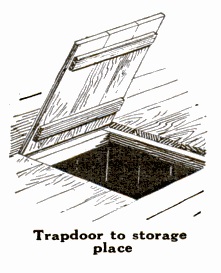
1923AugPM4The camping scow shown here was good for many years of service. It was hauled out of the water each year and stored, bottom up, out of the reach of ice. The boat featured plenty of storage space, including a waterproof box accessible through a trap door in the tent floor.

The scow would be hard to row with the tent set up, but was fairly easy to scull. Therefore, an oar lock or scull plate could be fixed to the roomy front deck.

Today, such a craft would undoubtedly need to be registered in most states, but this shouldn’t present a problem. In Minnesota, for example, a homemade boat over ten feet in length can be registered. But save the receipts for the materials, as you’ll need to present them, along with four photographs of the completed boat.


Solar Cooking, 1923

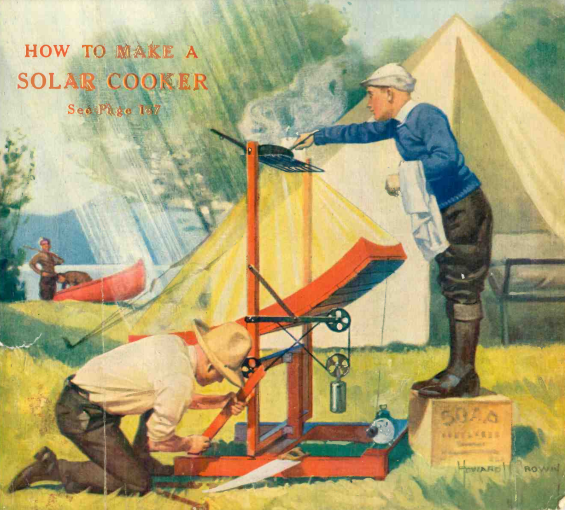
Screenshot 2023-06-05 12.28.16 PMHarnessing the power of the sun to cook your food is nothing new, as shown by this hundred-year-old illustration on the cover of Science and Invention, June 1923.

The accompanying article, penned by Dr. C.G. Abbott, the assistant secretary of the Smithsonian Institution, isn’t quite a construction article, but it does provide some basic ideas. The model shown above was suitable for camping, or other situations where fuel and power were unavailable. The two concave mirrors, made of tin, reflected the sun onto the cooking surface, the bottom of which was blackened with soot.  The complicating factor, possibly unnecessary, is the use of an alarm clock to keep the mirrors aimed.

For situations where it was necessary to cook at night or when there was no sun, the author also described a more complicated system, where the sun heated a reservoir of oil, which was in turn used to provide the cooking heat.

For a simple solar cooker, you can see our earlier post, where we provide plans for construction of a solar oven.  If you want to save the work, the solar cooker shown below uses the same principle as the 1923 design, but it somewhat more efficient with the parabolic mirror.  If you don’t feel like making your own, solar ovens are surprisingly inexpensive on Amazon.

While these can’t be used in the dark or on cloudy days, having the ability to cook using only the sun’s energy adds flexibility for camping or emergency preparedness.


Some links on this site are affiliate links, meaning that this site earns a small commission if you make a purchase after using the link.

1948: Homemade Mess Kit & Scout Signaling

1948AprBLx
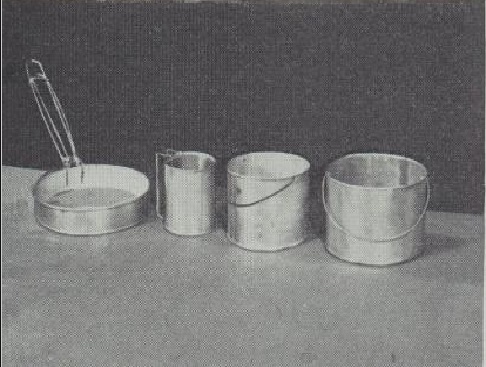
Today, if you buy a mess kit like the one shown at left, you can inexpensively take care of your cooking and serving needs for a camping trip of a few days. But if you want to economize even further, you can take advantage of the plans found 75 years ago this month in Boys’ Life magazine, April 1948.

A Scout is Thrifty, and the magazine showed those thrifty scouts how to make a similar mess kit out of old tin cans.  With a few simple hand tools, the cans can be cut to size.  The article showed a technique for smoothing the cut edge with a hammer.  Handles are made with stiff wire.  The author used a fly swatter handle, but a metal coat hanger would work just as well.

The article notes that almost any kind of can may be used, although it warned to never use a paint can.  It warned that since cans back then were neither aluminum nor stainless steel, it was important to dry the items thoroughly after washing.  However, modern cans are probably more forgiving.

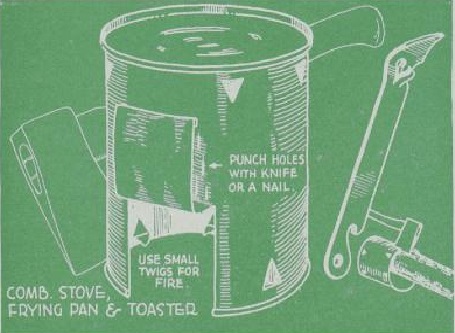
1948AprBL2Advanced scouts could construct from a one-gallon can the combination stove/toaster/frying pan shown at left.  It’s pretty self-explanatory–the fire goes inside the inverted can.  The door for putting in the wood fuel serves double duty, as it folds upward to provide a spot to snap a slice of bread in place for toasting.

While the idea seems novel, we suspect the inexpensive camping toaster shown at right is an overall better performer if you’re interested in making toast on a campfire or portable stove.

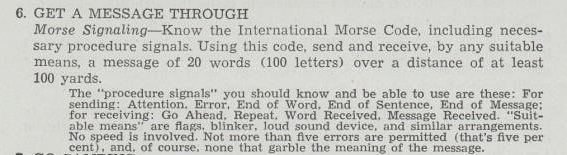
This issue of the magazine is also useful to scout historians, because it includes a removeable booklet section showing the Tenderfoot-Second Class-First Class requirements which had just been adopted.  Many of our readers, of course, will be interested to know what the signaling requirement was back then.  I recall that about the time I joined in the 1970s, the First Class requirement was that the Scout be able to use Morse Code or semaphore.  I’ve been told, although I haven’t confirmed it, that at one point, Scouts had to know both Morse Code and semaphore.  But in 1948, the requirement was for Morse code only, although it could be done with flags, light, or sound:

1948AprBL3


Some links on this site are affiliate links, meaning that this site earns a small commission if you make a purchase after following the link.


1937 Tent Stove

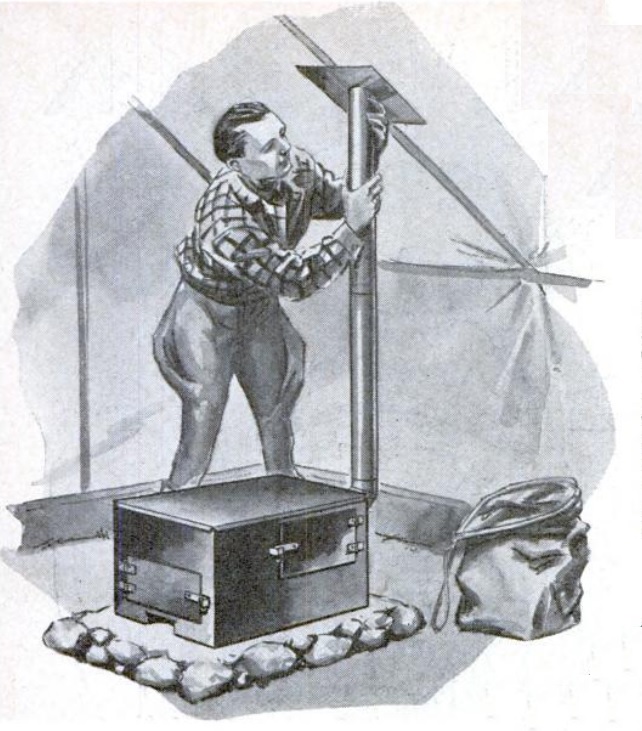
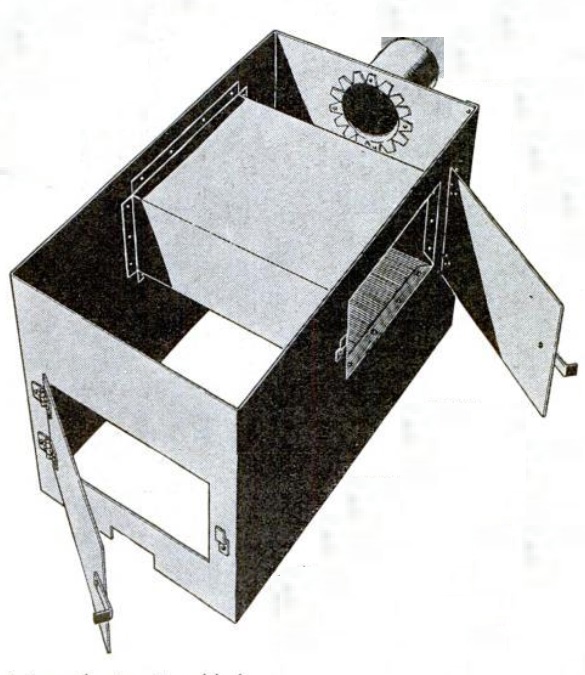
1937OctPsStove1937OctPsStove2For those wishing to extend the camping season into the cold months, the October 1937 issue of Popular Science showed how to make this lightweight wood stove for your tent.  If you need a lightweight wood stove for use in emergencies, it would serve that purpose as well.

It’s designed to burn with low oxygen, so when you get it started with kindling, you put in logs, and they give off most of their heat after they’re turned into charcoal. The result is that you can build the fire at night, it will keep you warm all night, and then you can cook your pancakes in the morning. The stove also features a small oven compartment.

It’s made out of sheet metal and riveted together, so it’s lightweight.

If you don’t feel up to building your own, the one shown here is available on Amazon at a reasonable price. And if you don’t want to cut a hole in your tent for the chimney, you can get a propane or kerosene heater that’s safe for indoor use. For more details, you can see our earlier post.


Some links on this site are affiliate links, meaning that this site earns a small commission if you make a purchase after following the link.

1942 Rex Ristlite Wrist Flashlight

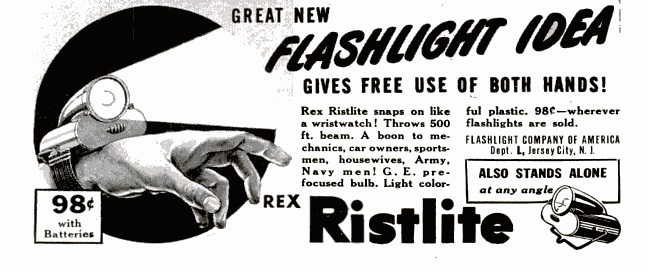
1942June22LifeThis ad appeared in Life Magazine 80 years ago today, June 22, 1942, extolling the virtues of the Rex Ristlite from the Flashlight Company of America of Jersey City, NJ.  The light snapped on like a wristwatch, giving you full use of both hands.  It was a “boon to mechanics, car owners, sportsmen, housewives, Army, and Navy men.”  It sold everywhere that flashlights were sold for only 98 cents, including batteries.  According to this online inflation calculator, that works out to $17.57 in 2022 dollars.

It seems like a practical idea, although it has been largely supplanted by the headlamp, of the type shown at left.  After all, if you need to look at something, then your head is going to be pointing in the right direction, so it makes sense to put the light there.  On the other hand, having it on your wrist could be handy in many cases, so they had a good idea 80 years ago.

And fortunately, the same thing is available today, only better.  And the price (including batteries) is almost the same as the 1942 price, adjusted for inflation, of course.  Like everything else, it is available at Amazon, and you can see it pictured at right.
This one also includes a clock (with 24-hour display, as our readers will appreciate) and compass.  It’s customary to wear a watch on your wrist, so the clock seems logical.  And since it appears to be much smaller than the 1942 version, you can wear it in situations where you might need a light, rather than putting it on as needed.  Many of the reviews state that the compass doesn’t work very well, although I suspect that it works well as long as it’s flat.  As long as it’s magnetized and spinning freely, there’s really not much that can go wrong with a compass.  So if you take it off an lay it on a flat surface, I imagine it will reliably point north.  And if you click on the Amazon link or the picture, you’ll see that the cost, adjusted for inflation, is about the same as it was in 1942.

One big advantage of the modern version is that you don’t have to worry about batteries.  It has a built-in lithium ion battery, and it comes with a micro USB charger.  If the charger gets lost, you can use the same one you normally use with your cell phone.


Some links on this site are affiliate links, meaning that this site earns a small commission if you make a purchase after clicking the link.

1946 Compass/Match Case/Fire Starter

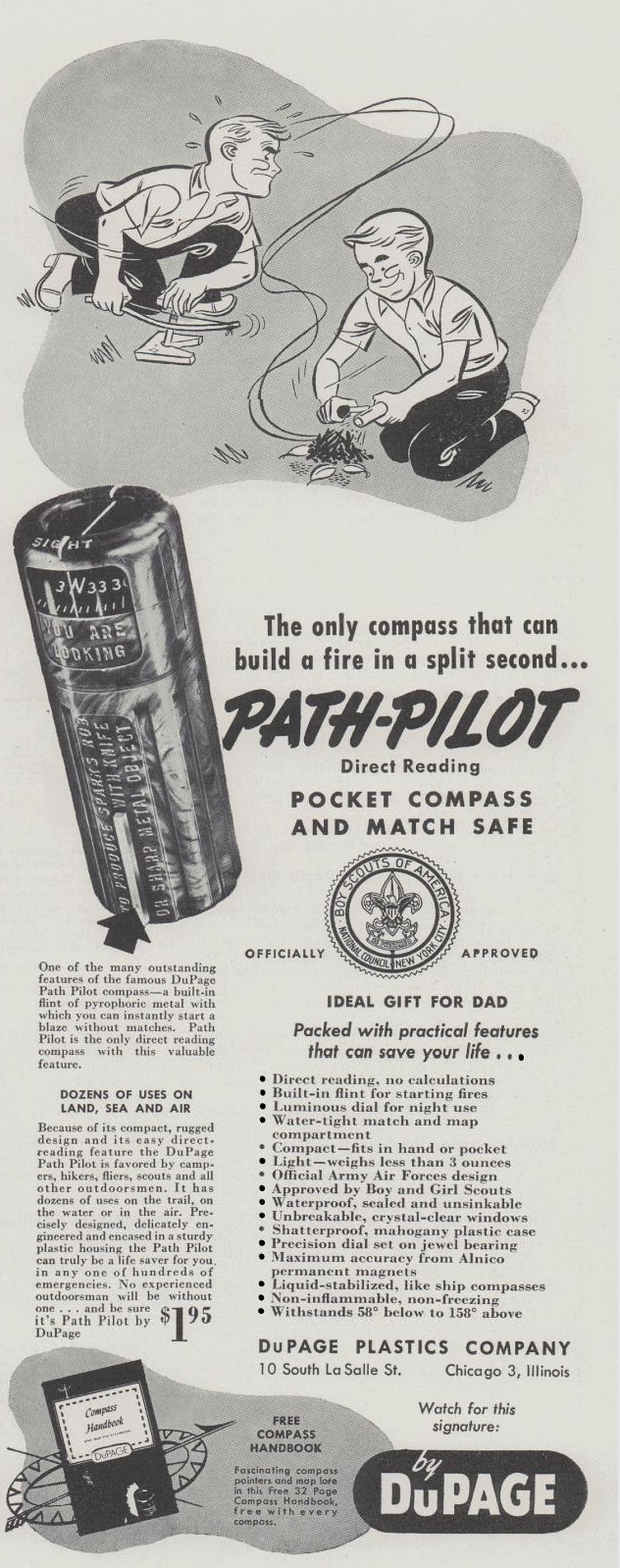
1946OctBLSeventy-five years ago this month, the well equipped Scout might have in his pack this combination compass, match safe, and fire starter. A compass was at the top, with a window to view the direction. To avoid confusion, the window was labeled “YOU ARE LOOKING” to make clear that if you saw an N, then you were looking north, rather than having the N printed on the north side of the dial.

Matches were stored in a watertight container, but just in case you ran out, the side had a “flint of pyrophoric metal” that could be struck by a knife. The ad declared that it was the only compass “that can build a fire in a split second,” and I’m guessing that would be done with one of the matches inside. With practice, the flint would probably work, but it would take some practice, and probably wouldn’t happen in a split second.

The product was manufactured by the DuPage Plastics Company, 10 South LaSalle Street, Chicago. It was officially approved by the BSA, and is advertised here in the October 1946 issue of Boys’ Life.


While this particular model is no longer available, there is a modern replacement, shown at left. I have one of these, and while I’m not sure it’s from the same manufacturer, it looks identical. There’s a compartment for storing matches, and as far as I can tell, it is waterproof. Strike anywhere matches are still available, but they’re often hard to find. I simply use regular strike on box matches and include one of the strikers from the box inside with the matches. If all else fails, it does include on the side what is now called a ferro rod.

The modern version also includes a whistle, which is quite loud, as well as a tiny mirror inside the cap, which presumably could be used for signaling.

I’m guessing that the compass on the 75 year old version was better than the modern one, but the modern one does, indeed, work. You have to be careful, however, because if you don’t hold it perfectly level, it will bind up and not move. The best way to use it is to check it once, and then check a second time to make sure that north hasn’t moved.

Especially if you buy the three pack, the modern version is very inexpensive.  Like this Scout 75 years ago, it’s not a bad idea to have one of this in your pack.


Some links on this page are affiliate links, meaning that this site earns a small commission if you make a purchase after clicking on the link.

Expedient Tent Frame

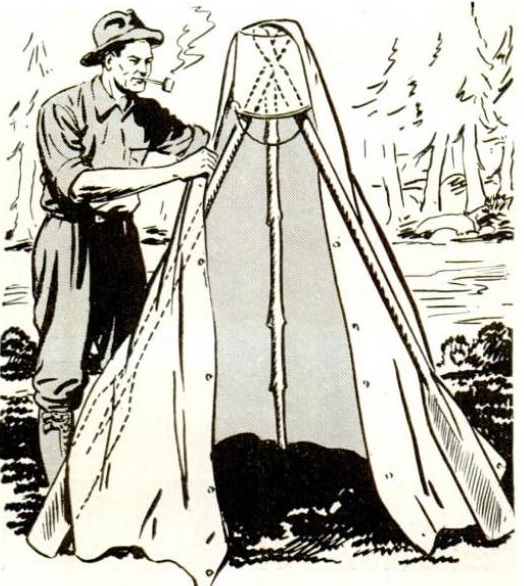
1941OctPMEighty years ago this month, the October 1941 issue of Popular Mechanics carried this self-explanatory idea to quickly make an emergency tent with materials that might be at hand. Any poles of similar length could be used, but in this case, it’s two oars and another stick of the same size. To quickly turn them into a tripod, a bucket is placed over the ends as shown. The frame is then covered with a piece of canvas or other available material.

If the idea looks familiar, it’s probably because we previously showed how to make a similar tripod for cooking using an empty can.


How to Use USPS General Delivery

generaldeliveryOccasionally, we need to write about very simple concepts, because we have discovered that those simple concepts are at risk of being lost to the ages. For example, you can find on our website instructions on how to make coffee without electricity.

Another simple concept that many people apparently don’t know about is the concept of General Delivery.  Did you know that you can receive a letter or package by snail mail, even if you don’t have your own address?  You can, and you can do it at almost any Post Office in the United States, or indeed, in the world?

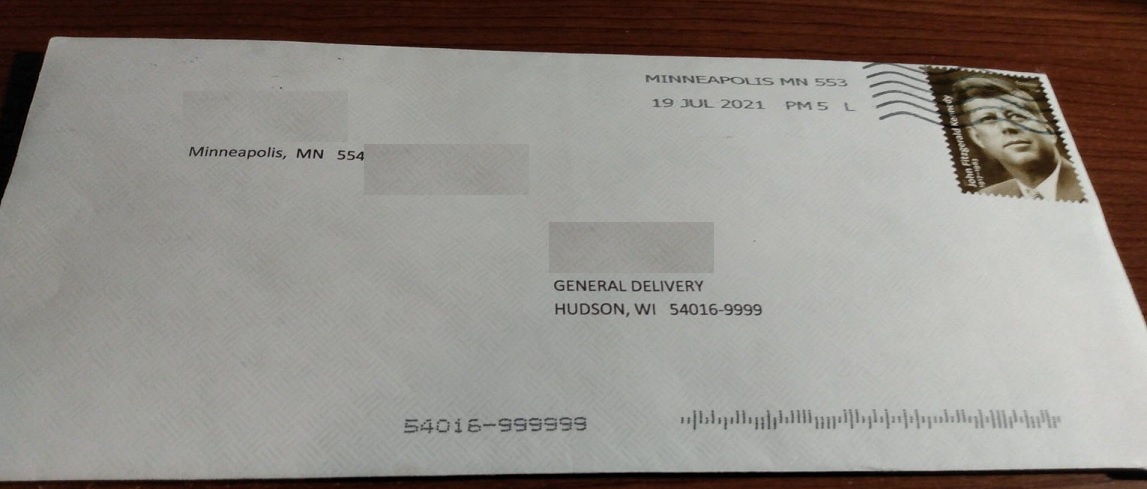
I mailed the letter shown above to myself, but it didn’t come to my home or business.  I picked it up at the Post Office in another state where I don’t live, and have no connection.  I did this by mailing it to myself at “General Delivery.”  I waited a few days, and then picked it up at the Post Office in the town to which I sent it.

Why You Might Need General Delivery

MovingImageHHSdotGOVThere are many reasons why someone may need to take advantage of the General Delivery service.  When I asked the postal clerk, she said that the most common reason was people who were temporarily between addresses and had to receive mail.  For example, someone might move out of one apartment but can’t move into their new home for a few days.  In the meantime, they might stay in a hotel or stay with friends.  If they don’t know exactly where they are going to be staying, but need to receive mail during this time, they can receive mail by General Delivery.

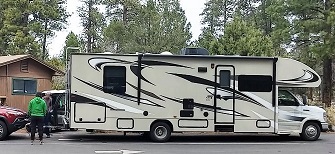
NPSRVphotoGeneral Delivery is also useful for people who are traveling.  For example, many full-time RV’ers take advantage of General Delivery.  If you live in an RV, you probably have a permanent address set up somewhere.  But if you decide to order something on Amazon, you will want it sent to you on the road.  If you know exactly where you will be staying, sometimes you can have it sent to the campground or motel.  But if you don’t know exactly where you will be staying, you can take advantage of General Delivery.

NPSApTrphotoGeneral Delivery can also be part of an outdoor experience.  For example, hikers hiking a long distance, such as thru-hikers on the Appalachian Trail can arrange to have supplies such as food and clothing mailed to them at towns along the trail.

One way to send money to a stranded traveler is to send them a Postal Money Order via General Delivery.  They can usually cash the money order right at the Post Office.  (For more information on money orders, see my Money Order Basics page.)

If you are ever relocated due to a natural disaster or emergency, General Delivery could be an important way to stay in touch.  If you are displaced, you can ask friends to send you needed items or even money by General Delivery to the closest Post Office.  After a disaster, the Post Office is often one of the first services to re-emerge.  And in outlying areas away from the disaster, it will probably continue to operate without interruption.  If you are forced to relocate, then General Delivery can provide you with a needed mailing address.

There might be situations where someone needs to receive mail without the knowledge of their roommates or nosy neighbors.  If so, they can arrange to have the item sent by General Delivery.  Or, there might be situations where a service is provided only to persons with an address in a certain ZIP code.  A General Delivery address might provide that ZIP code.  Finally, General Delivery provides a method for homeless persons to receive mail.

In short, any time you need to receive mail but don’t have an address, you can use a General Delivery address.

How and When To Send General Delivery

Practically anything that can be sent by mail can be sent to General Delivery.  It can be a letter or a package.  To make sure you get it, you’ll need to make sure that the sender follows these instructions carefully.

First of all, they need to figure out when to mail it.  There might be exceptions, but you can generally plan on the Post Office holding the item for about two weeks.  If they send the item too late, then it won’t arrive in time.  But if they send it too early, then it might be returned to the sender before you pick it up.

In my example above, I mailed the letter from Minneapolis, MN, on a Monday.  I went to the Post Office to pick it up on Thursday, but it hadn’t arrived.  I went back a week later (a total of 10 days after mailing) and it was there.  I would recommend planning on it taking about one week, so have them mail it one week before you plan to pick it up.

If the timing is more critical, then it might be best to send the item by Priority Mail or Express Mail.  If you mail early enough in the day, then Express Mail is almost always delivered the next day, almost anywhere in the country.

Finding a Post Office

Next, you need to decide on the Post Office at which you will get the letter.  Most Post Offices offer General Delivery, but not all of them do.  There are exceptions, but in large cities and their suburbs, General Delivery is available only at the main downtown Post Office.  For example, I live in the Minneapolis-St. Paul area.  In Minneapolis and suburbs, the ZIP codes begin with 554.  In St. Paul and suburbs, the ZIP codes start with 551.  In those suburbs with 551 and 554 ZIP codes, General Delivery is available only at the downtown Post Office.  You can’t get general delivery at the neighborhood Post Office.  This is true in other cities as well.  For example, in Chicago, in any area with a 606 ZIP code, the only place to get General Delivery is the main downtown Post Office.

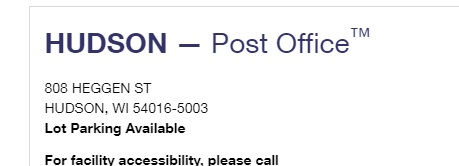
If you live or work downtown, this is great.  But going downtown isn’t particularly convenient for many people these days, so if you are in an urban area, the most convenient place to get General Delivery might be an outlying suburb.  In general, if the first three digits of the ZIP code are not the same as the main city Post Office, then that Post Office will have General Delivery service.  So in the Minneapolis-St. Paul area, most of these outlying suburbs have a ZIP code starting with 550.  In general, all of these post offices offer general delivery.  Since I had to drive a few miles anyway, I decided to send my experimental General Delivery letter to another state, to Hudson, Wisconsin, ZIP code 54016.

In general, small town Post Offices will have General Delivery available.  If you are sending something to a larger city, then you will need to check more carefully on which post office to use.

There are exceptions to all of these rules, so before deciding on a Post Office to use, you should look it up on the USPS website.  From the main page, select “Find USPS Locations” from the menu.  Then, click on the Post Office you are interested in.  The hours will be listed.  For larger towns, it will be open about 9:00-5:00 Monday through Friday, and Saturday mornings.  Almost all Post Offices will be closed on Sunday.  In small towns, the hours might be much more limited, such as just a couple of hours in the morning.  So before selecting a Post Office, be sure to check that you will be in that town at a time when the Post Office is open.

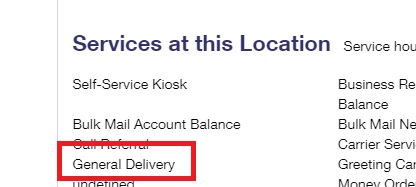
generaldelivery2Then, scroll down to “Services at this Location.”  If General Delivery is offered, it will be shown on this list.  If it’s not listed, you’ll need to pick another Post Office.

After confirming that the Post Office offers General Delivery service, scroll to the top of the page, where you will see thegeneraldelivery3 address of the Post Office.  The street address is shown.  You’ll obviously need this information later, so that you can find the Post Office to get your letter.  The person sending the letter, however, will not need the street address.  Instead, they will need the City, State, and first five digits of the ZIP code (but not the last four).  So in this example, they will need:  HUDSON, WI 54016

Addressing the Letter

Once you have found a Post Office where you can get your item, the sender can address the letter or package.  The letter should be addressed with your full name.   You will need to show identification when you pick up the letter, so make sure the letter is addressed to your real name, and not a nickname.  The second line of the address should be:  GENERAL DELIVERY.  The third line of the address should be the City, State, and ZIP code.  The nine-digit zip code for General Delivery always ends in -9999.  So they should include this after the five digit ZIP.  So in the example above, the ZIP code is 54016-9999.

Here’s an example of the address.  You are sending a letter to John Q. Public, and he will pick it up at the main Post Office in New York City at 421 8th Avenue:

John Q. Public
General Delivery
New York, NY  10001-9999

Make sure the sender includes their return address.  If something goes wrong, the letter will be returned to them.  Of course, they should make sure to include enough postage, which they can calculate online.  If it’s a small item they’re sending, the postage for a letter of up to one ounce is 63 cents (as of April 2023), or one “Forever” stamp.  (For information on how to buy stamps, see our Buying Stamps During Quarantine page.)

Picking Up Your Item

After you have given enough time for your letter or package to arrive, you simply go to the Post Office to which it was sent.  Just tell the clerk that you are expecting a General Delivery letter or package.  They’ll go to the back room, and if it’s arrived, they will bring it out.  You will need to show identification.  When I picked up my letter, my out-of-state driver’s license was all I needed for ID.

General Delivery in Other Countries

The instructions on this page are specific to the United States, but most other countries offer the same service.  So if you are traveling in another country and need to receive mail, you can probably take advantage of this service there.  In most other countries, the service is called “Poste Restante

Other Alternatives

The USPS is not the only way to send items if you don’t have a permanent address.  Private delivery services such as UPS and FedEx allow you to pick up packages at fixed locations.  However, USPS is still the least expensive.  You can send a letter anywhere in the United States for only 55 cents.

And keep in mind that if you are buying an item from Amazon, another alternative is to have it sent to one of their lockers  located all over the country.

The USPS official information about General Delivery can be found on their website.


Some links on this website are affiliate links, meaning that this site earns a small commission if you make a purchase after using the link.

1921 Homemade Catamaran

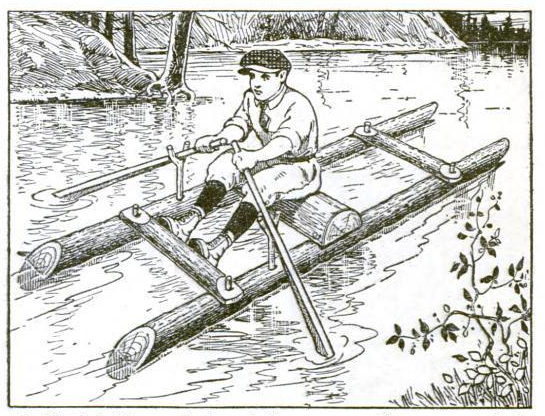
Screen Shot 2021-06-03 at 9.50.28 AMA hundred years ago this month, the June 1921 issue of Popular Mechanics showed these self-explanatory plans for a homemade raft.  The magazine specifies that the hulls should be logs of about 12 feet.  However, in many states, such a craft would require a license.  In most cases, this can be avoided by making the craft slightly smaller.  For example, Minnesota requires no license for a non-motorized craft of 10 feet or less.

For any size boat, including this one, most states have a certain level of minimum equipment.  For example, Minnesota requires life jackets and a white lantern or flashlight visible for at least two miles.

While most states do not require adults to wear the flotation device, in the case of this homemade expedient raft, it would be highly recommended.


1921 Recreational Vehicles

1921MarPM1This early proto-recreational vehicle was shown a hundred years ago in the March 1921 issue of Popular Mechanics. The magazine notes that this vehicle, called an “auto-bungalow” was “the culmination of a movement which had been growing ever since the motor car became a reliable means of transportation. It ancestor was the two-wheeled homemade camp trailer, designed to carry the tents, bedding, and other simple requisites of a two-weeks period of “roughing it” in the woods or at the shore.”

The early RV shown above was not cheap. According to the magazine, the total cost was $16,000. According to this inflation calculator, that would work out to almost a quarter million in today’s money, a figure that’s not surprising, since many top-end RV’s are available today in that price range. The vehicle, including the rear porch, had an overall length of 30 feet. As is apparent, it required an abnormally long overhang at the rear, but the magazine pointed out that this was an advantage, since it put most of the weight on the rear axle, providing better traction and making steering easier. The interior living quarters measured a respectable 8 by 20 feet, which included a kitchenette with ice box, stove, hot water tank, and fireless cooker. It included toilet facilities and 22 incandescent lights powered by battery and generator.

1921MarPM2


As is the case today, not everyone could afford such a top-of-the-line luxury RV, and the magazine pointed out a number of options for the more budget conscious. For example, the “20th century prairie schooner” shown at left was constructed at reasonable cost by a Kansas City resident. It was built on the chassis of a popular make of light car, with the wheelbase extended several inches. The even simpler equipment shown to the right 1921MarPM3was designed by a Maine resident at a total cost of $312, including two new tires. This family of six cooked most of their meals on campfires.


Modern tent trailer for motorcycle or small car. Amazon photo.

The tent trailer shown below is similar in concept to some modern motorcycle camping trailers. According to the magazine, a number of such trailers, with either two or four wheels, were readily available for purchase, for the benefit of those with “neither the leisure nor the ingenuity to originate and build outfits.”

1921MarPM4