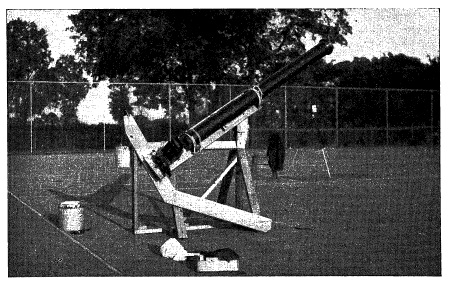
 Seventy-five years ago today, April 7, 1940, an annular eclipse occurred, the center line of which passed through Texas and the southeastern United States. Professor N. Wyman Storer of the University of Kansas took the opportunity to travel to Conroe, Texas, the closest point on the center line. There, he and assistants set up the University’s 6-inch refractor, shown here, on the tennis court of the Conroe High School, where he captured a number of good photographs of the eclipse. The telescope was acquired by the University for $1000 in 1885, and was still in use as late as 1968. The mount shown here was made of lumber, and cost $3. The photos taken during this expedition can be found in the August 1940 issue of Popular Astronomy.
Click Here For Today’s Ripley’s Believe It Or Not Cartoon