Author Archives: clem.law@usa.net

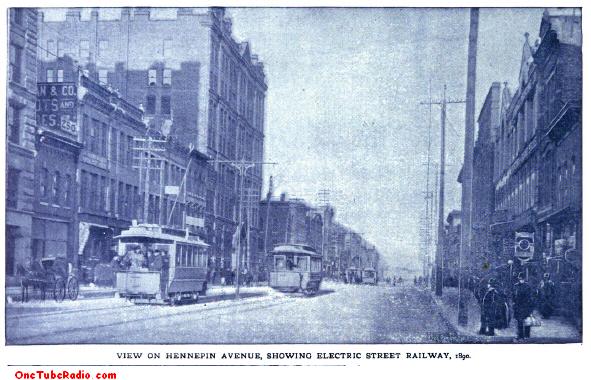
Hennepin Avenue, Minneapolis, 1890

Hennepin Avenue, Minneapolis, 1890

Hennepin Avenue, Minneapolis, 1890

This interesting old public domain picture shows Hennepin Avenue in Minneapolis as of 1890.  I don’t know the exact location, but I get the idea that it’s looking south.

It can be found in a pamphlet entitled Minneapolis: An Art Study of the City and Its Surroundings published by the Minneapolis Realty Company in 1891.  The little book extols the virtues of the city and explains “good, honest, business-like reasons why parties having surplus capital for investment will find it for their advantage to make such investment” there.

The book is available for free download at Google Books.


A Golden Age of Journalism and Politics?

It is often supposed that there was a “Golden Age” in which journalism, politics, and the law were marked with civility. The problem with this theory, however, is identifying exactly when this supposed Golden Age exited. We can safely rule out 1851, as evidenced by an incident involving James Goodhue, the editor of the Minnesota Pioneer, Minnesota’s first newspaper, which still exists in the form of the
Pioneer Press.

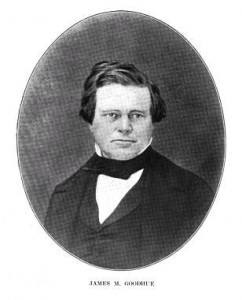
James Goodhue

James Goodhue

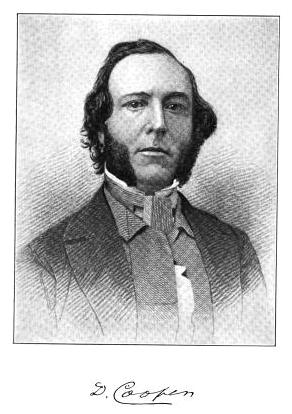
This incident began with the publication of an editorial in the January 16, 1851, of the Pioneer. In that editorial, editor James Goodhue was highly critical of U.S. Marshal Alexander Mitchell, and Supreme Court Justice David Cooper.  Of Cooper, the editorial stated:

He is not only a miserable drunkard, who habitually gets so drunk as to feel upward for the ground, but he also spends days and nights and Sunday, playing cards in groceries. He is lost to all sense of decency and self respect. Off the Bench he is a beast, and on the Bench he is an ass, stuffed with arrogance, self conceit and a ridiculous affectation of dignity. . . .  On his passage up the Minnesota river last summer, paying such attentions to a certain California widow on board, as a sot well could pay, he not only kept drunk, but when the boat returned to Fort Snelling, and the news there met him, of the death of his wife in Pennsylvania, he was so shamefully inebriated, that the awful intelligence scarely aroused him.

Justice David Cooper

Supreme Court Justice David Cooper

An advance copy of the paper found its way to on January 15 to Joseph Cooper, the younger brother of the judge. He confronted Goodhue on the street with his fists, and both men drew guns. The Sheriff of Ramsey County, along with some bystanders, managed to initially break up the fight. The younger Cooper, however, managed to charge Goodhue with a knife and stab him in the stomach. Goodhue also managed to break free and shot Cooper in the groin.

No charges were pursued by either man, and Goodhue recovered from his wounds after being confined to his bed for several weeks. Joseph Cooper, on the other hand, was said to have died some two or three months later, “his death being hastened by the pistol wound he had received”.

Justice Cooper’s term expired in 1853. He remained in Minnesota practicing law until 1864, when he moved to Nevada Territory. He is said to have died “in darkness” in an inebriate asylum in Salt Lake City.


References:

Holcombe, et al, Minnesota in Three Centuries, Vol. 2, pp. 449-50 (1908).

Memoir of Judge David Cooper

Hage, Newspapers on the Minnesota Frontier, pp. 35-38 (1967).

Marray, Recollections of Early Territorial Days and Legislation, Collections of the Minnesota Historical Society Vol. 12, p. 103, 113 (1908)

Elliott, The Supreme Court of Minnesota, The Green Bag, Vol. 4, pp. 113, 118 (1892).

1920 Ad for Maxim Silencer

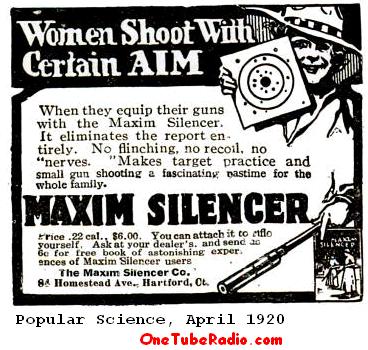
On my way to looking up something else, I found the following advertisement for the Maxim Silencer in a 1920 issue of Popular Science.

1920 Ad for the Maxim Silencer

1920 Ad for the Maxim Silencer


To Amateur Radio Operators, Hiram Percy Maxim is best known as the founder of the ARRL.  But he was also the inventor of the first commercially viable silencer for firearms, and the same techniques were adapted to automobile mufflers.  In fact, Maxim Silencers, Inc., is still in business producing silencers for industrial equipment.

The following links may be of interest:


Expedient Winter Shoes from Newspaper

Even if you’re not contemplating a nuclear war, the book Nuclear War Survival Skills by Cresson H. Kearney is chock full of interesting information.  This book is freely available at various sites, including the Google Books link above.  It is based on research done by the author while employed at the Oak Ridge National Laboratories, and was published and placed in the public domain after his retirement.

One of the items that I’ve always found intriguing is the description of homemade winter boots found in Chapter 15.  Here are Kearney’s instructions for making boots from newspaper:

IMPROVISED WINTER FOOTWEAR

Cold-weather footwear that is warmer than all but the best-insulated winter boots can be improvised readily. The trick is learning how to tie the several insulating layers securely in place, so that you could hike for miles in the snow if necessary.

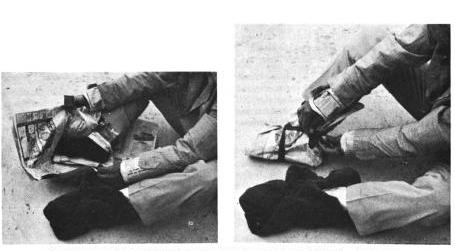
For use in dry snow, first tie a porous insulating layer—such as two bath towels or 10 big sheets of newspaper -over each shoe. If you have no lowheeled shoes, make a paper sole by folding 3 large newspaper sheets to make a sole that has 72 thicknesses of paper. Then proceed in the following manner:

1. Place your foot and the sole on 10 newspaper sheets, as pictured in Fig. 15.5.

KearneyFig155a

Fig. 15.5. Insulating a foot with a folded newspaper sole and 10 sheets of newspaper.

2. Fold all the sheets over the top of your foot while keeping the sole in the proper place, as indicated in Fig. 15.5.

3. Use a strip of cloth about 3 inches wide and 5 feet long to tie the papers in front of your ankle with a single overhand knot (half of a square knot). With the same strip, tie another single overhand knot over the tendon behind the ankle. Finally, tie a bow knot in front of the ankle.

4. Cover the insulating layer with a tough fabric, such as canvas or burlap sack material; secure with a second strip of cloth and tie as described above.

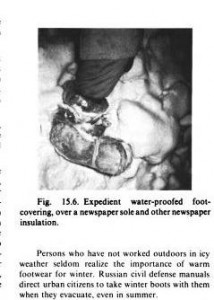
KearneyFig156If the snow is wet, place a piece of strong plastic film or coated fabric outside the insulating layer, after securing it with the first strip of cloth. The outer protective covering should be tied over the waterproofing, with the second strip of cloth securing both it and the waterproofing. (When resting or sleeping in a dry place, remove any moistureproof layer in the foot coverings, to let your feet dry.) Figure 15.6 shows a test subject’s waterproofed expedient footcovering, held in place as described above, after a 2-mile hike in wet snow. His feet were warm, and he had not stopped to tighten or adjust the cloth strips.

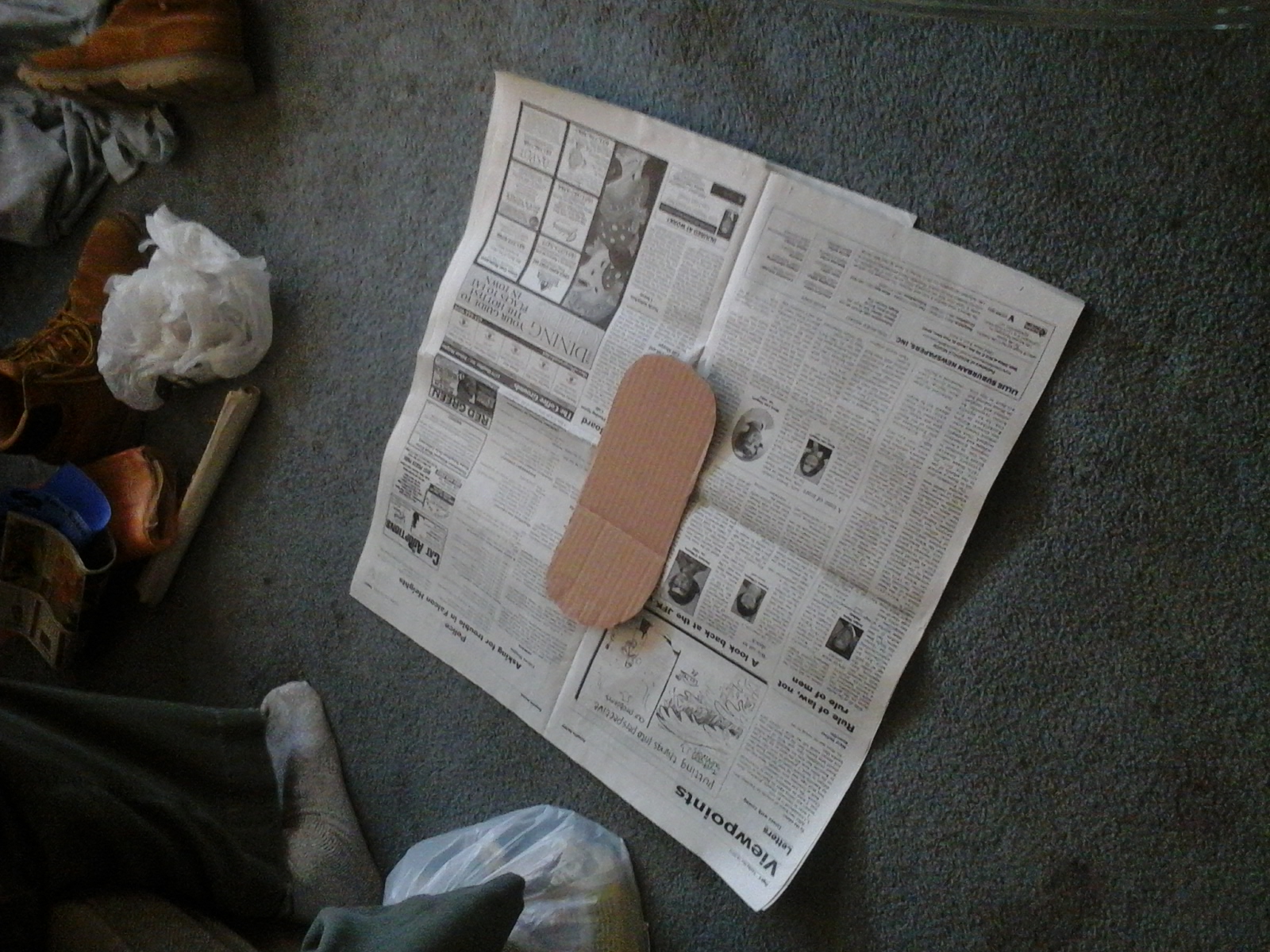
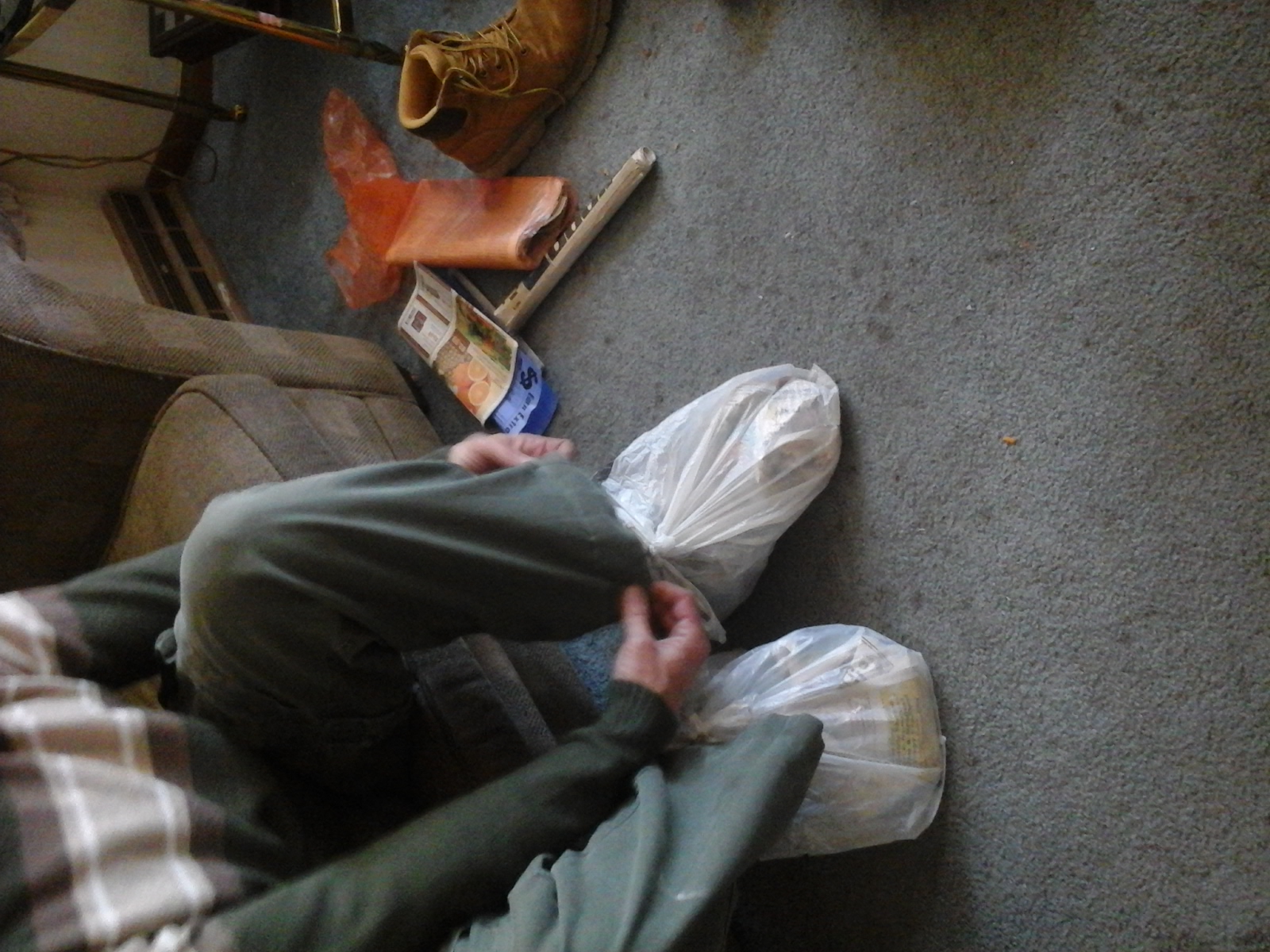
20140105_144109Since the temperature this afternoon was about -10 degrees Fahrenheit, it seemed like an ideal day to test this expedient footwear.  Since I was using it for only a short test close to home, I didn’t bother using the full ten sheets of newspaper called for by Kearney’s design.  Instead, I started with a sole

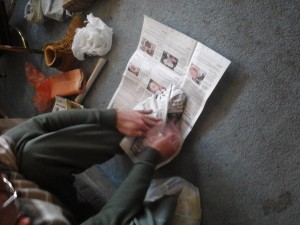
20140105_144144made of corrugated cardboard, and used only about three sheets of newspaper.  I then tied these as indicated in Kearney’s instructions.  I finished by covering them with a plastic grocery bag.

20140105_144349

The completed shoes.

The completed shoes were surprisingly comfortable, and they also kept me surprisingly warm and dry as I walked around for a few minutes outside.  I was able to walk quite comfortably through a snowbank.

With the very thin insulating layer, I’m sure that my feet would have gotten cold eventually.  But the concept obviously works, and with more insulation, I think I could have stayed outside indefinitely.

Also, in a true survival situation, I would want to have the waterproof layer by considerably more durable than the thin grocery bags I used.  Eventually, the thin plastic would have torn, my feet would have gotten wet, and I would be in a lot of trouble.  But for my short venture outside, these proved perfectly adequate.

Of course, after seeing me test these, my kids wanted to give it a try themselves, and they both made themselves a set of emergency winter boots.  So yes, I allowed my kids to go outside without shoes with the temperature of ten below zero.


For more interesting emergency preparedness books, see my listing of free e-books.


The Bomb Shell of Fort Ripley, Minnesota

Bomb Shell Newspaper, 1854

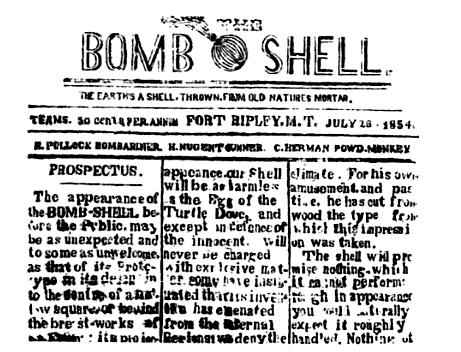
The Bomb Shell, an almost forgotten piece of journalism history.

If you’ve looked at my hectograph page, you might have guessed that I’ve always been intrigued by primitive printing methods.  As that page shows, you can whip up a little printing press in the kitchen.  According to Wikipedia (unfortunately, no sources are cited for the assertion), a hectograph was used by allied prisoners of war in World War 2 to make documents for a planned escape attempt.

A more laborious method was employed by three soldiers at Fort Ripley, Minnesota Territory, in the summer of 1854, when they published their newspaper the Bomb Shell.  According to its masthead, the Bomb Shell is the handiwork of R. Pollock, the “Bombardier”, H. Nugent, the “Gunner”, and C. Herman, the “Powder Monkey”.  It bears the motto, “the Earth’s a shell, thrown from old nature’s mortar.”  The prospectus issue indicates a subscription rate of 50 cents per year, but there’s no indication that any issues other than the first, dated July 28, 1854, were ever dispatched from that mortar.

This newspaper is unique in that it was produced with hand-carved type.  These early proto-bloggers didn’t let the lack of technology stand in their way.  With a pocket knife, they carved out the type, set it by hand, and printed their own newspaper.  According to its first issue, “the appearance of the BOMB-SHELL before the public may be as unexpected and to some as unwelcome as its prototype.”  It goes on to say, however, that the new paper “shall be as harmless as the egg of the turtle dove and except in defense of the innocent, will never be charged with explosive matter.”

The editor of another Minnesota newspaper described it thus:

Its contents are lively, and entertaining but it is not on that account only, we desire to see “Bomb Shell” succeed. To the eyes, it is an uncouth, ill-printed, muddy-looking sheet, and every letter in it is larger than those in a child’s Primer–but all these drawbacks are more than compensated for, by the knowledge that all the letters and furniture used in setting up the paper, were made by one of the soldiers in the Fort, his principal tool to work with, being a small pocket knife. Those who know how necessary it is to accurately square and level types, to make them serviceable at all, will readily agree with us that this is a wonderful exercise of skill, patience, and ingenuity.

Minnesota Democrat, August 23, 1854, reprinted in Douglas C. McMurtrie, “The Printing Press Moves Westward,” Minnesota History, Vol. 15, No. 1, p. 24 (Mar. 1934) (available online).

I know there is one copy of the Bomb Shell in the collections of the Minnesota Historical Society, but it’s unfortunately not available online. In addition to the article cited above, the Bomb Shell is also referenced in Newspapers on the Minnesota Frontier by George Hage.


What George Can Tell Us About Privacy

The other day, I received a dollar bill with a stamp inviting me to visit WheresGeorge.com.  That site allows you to track currency as it circulates naturally through the economy.  One “Georger”, as users are called, enters the note’s serial number, (optionally) marks it, and then spends it.  The idea is that someone else coming into possession of it will see the stamp, and update its location before releasing it back into circulation.  Interestingly, about one piece of circulating currency in a thousand is registered at this site.  The dollar bill I was holding was spent in Bismarck, North Dakota, a few months ago.  Whoever recorded it in Bismarck was presumably informed that I received it, and will be able to keep tracking it as it continues to circulate.

My son saw me on that site, asked what it was, and in response to my explanation, he proclaimed that it was “cool”.  I tend to agree.  It appears to be an interesting hobby, not unlike Amateur Radio, (or sending out a message in a bottle or helium balloon) in that something is sent out into the environment to fend for itself, and it’s interesting to see just where it winds up.  One can order the rubber stamp for a mere five dollars (or an “Abe”, as Georgers would call it) postpaid, and I suspect Santa will be bringing us one.

In short, it appears to be a fun hobby.  But it also demonstrates something about privacy in an era in which the NSA can spy on its citizens with seeming impunity.  I have no doubt that the NSA, if it wants to, can easily look up every phone call I’ve made, every e-mail I’ve sent, and every letter I’ve sent and received.  I suspect that they can easily retrieve the contents of the phone calls and e-mails.

I suspect the U.S. Postal Service, bless their hearts, still stubbornly defends the integrity of the envelope, and there’s probably little chance that the NSA is privy to contents of the mail.  There’s something to be said for bureaucratic momentum, and I suspect there’s enough bureaucratic momentum at the post office for them to cling to the archaic notion that the mail can’t be opened without the right procedures being followed.  Since Ben Franklin was the one wrote those procedures, they’re probably still more or less in line with the Fourth Amendment.

I also have little doubt that the NSA can easily access all of my banking transactions.  If they care to find out, they can get a pretty good idea of everything I’ve purchased.  (And as you can see, Mr. or Ms. NSA Contractor, it’s all pretty mundane.)

I think that most people realize, or at least suspect, that all of this is true.  So to preserve their privacy, some people resort to spending only cash.  The idea is that the cash is anonymous.  Perhaps I’m wrong about the sanctity of an envelope at the post office.  But they are certainly wrong about the anonymity of their cash.   This is proven by the existence of WheresGeorge.com.  I know that one particular piece of currency was in Bismarck a few months ago.  I know (and now, thanks to me, the whole Internet knows) its location this week.  And it would surely be a trivial matter for the NSA to check my identity and that of the person who spent the bill in Bismarck.

It is quite true that this doesn’t really reveal anything particularly interesting.  The note in question passed through hundreds or thousands of hands before it got to me.  Even if the Georger in Bismarck was a notorious terrorist, the link to me is very tenuous.  But we do know a few things.  We know to an absolute certainty that someone crossed the Red River (or at least went around it) carrying this particular piece of currency.  We know this fact because of the note’s presence in two different places at two different times.  This is not a very profound piece of information.  But the reason why it’s not very profound is because only one note in a thousand is registered, and there are only so many Georgers doing the data entry.

But as more notes are tracked, the amount of information we can derive does not increase linearly.  Instead, it increases exponentially.  In other words, if twice as many bills were being tracked (1 in 500, instead of 1 in 1000), or if twice as many people were tracking them, then we would be able to figure out about four times as much information.  We would be four times as good at tracking down when the note was at a certain point, and where it was at a certain time.

Let’s look at the example of having twice as many people tracking the bills.  Currently, we know that a bill traveled 500 miles in 6 months.  But with twice as many people tracking, then we would probably know that it moved 250 miles in 3 months.  Increasing the number of bills being tracked would probably also increase the total amount of information available in a similar exponential fashion.

And if we increase both the number of people tracking and the number of notes, then the total available knowledge increases by a power of 4.  In other words, we now know 16 times as much information.  In other words, we would be able to narrow down the location of the bill in terms of movements of about 30 miles every 11 days.  We’re still not at the point where we can get much information about individuals, but we are getting much closer.  If we double everything again, we can now narrow down the location to about 2 miles, and less than one day.  Double it again (in other words, track 8 bills out of a 1000 instead of 1, and have 8 times as many “Georgers”) then we can narrow down the location to an eighth of a mile, and less than an hour.  We are now at the point where we can start to monitor individual behavior.  If we know that one individual was in that 1/8 mile radius, and he was in another 1/8 mile radius an hour later, it’s very likely that this is the person with the dollar bill.  And of course, if we have additional information available, then the likelihood becomes even greater.

In order to do this, you probably need to be smarter than me, and you probably need more computing power than I have.  I’ll leave it to the reader to consider who might have a lot of smart people with a lot of computing power.

Now, I’m sure the NSA has better things to do than hack into the WheresGeorge.com database.  All of that data is already readily available to them.  But I suspect they want cleaner data and more data.  And it seems to me that such data will become more and more available.

The cashier at the Kwik-E-Mart probably counts the till by hand, and doesn’t keep any records of what notes are in the till.  But he deposits some of them, and he hands the rest of them out as change.  The deposits are counted at the bank, and at some point, they are counted automatically.  And presumably, most large retailers count the money themselves, and probably do it automatically.  And many of the people who got change at the Kwik-E-Mart will spend it at a large retailer.


In fact, if the Kwik-E-Mart takes in enough cash, it might be worthwhile for them to buy their own counter. This money counting machine, for example, is very reasonably priced.  It can automatically distinguish between denominations, and it’s even set up for numerous currencies.  There is no indication that it can scan serial numbers.  But adding that capacity would be a trivial matter.  After all, if it can distinguish between a five dollar bill and a fifty dollar bill, or between a U.S. dollar and a Canadian dollar, or between a Euro and a Peso, then adding the additional capacity to scan serial numbers could easily be handled by software.

Nor is there any indication that this machine can be connected to a computer.  But this could be done with very little additional cost, and would add both convenience and security for the owner of the machine.  The manager of the Kwik-E-Mart could balance his books at the end of the day quite easily–just put the money in the counter, and let the computer print the deposit ticket.  This could also add security, since an employee counting the cash wouldn’t have the opportunity to “accidentally” enter the wrong amount after the bills were counted.

I don’t know if more expensive counters already have these features.  But they certainly will sooner or later.  The cost to add them is very low, and at least a few customers will want them.

Of course, many money counting machines are already connected to computers.  These include the automated check out lanes at the supermarket.  There’s no reason why they couldn’t record serial numbers.

In other words, if it hasn’t happened yet, it will very soon.  And as a result, there will soon be a large database of serial numbers, times, and locations.  This data will be stored on individual computers owned by retailers and banks.  Of course, there will not be any need to store this information in a centralized location, and it will probably be stored securely.  In other words, it will be quite similar to cell phone metadata.  And probably more useful.



Mister, we could use a man like Herbert Hoover again. Part 2: Good American Food for Your Folks in Europe

001


One of the galleries of the Hoover Library and Museum is dedicated to his years as a humanitarian.   Hoover was a self-made millionaire as a mining engineer.  He was in London at the outbreak of the First World War, and essentially took it upon himself to repatriate many Americans who were there at the time.   He was later called upon by the U.S. Government to organize relief for Belgium which he did, despite vehement criticism that he was aiding the enemy by bringing food to the citizens of of Belgium. Interestingly, one of the protests was that he was prolonging the war.  The argument was that the Germans should have to deal with the inevitable food riots if the innocent civilians of the occupied country were simply left to starve.

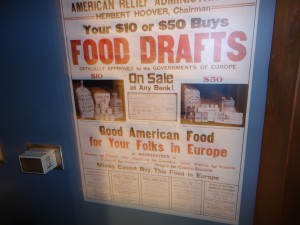
After the war, Hoover continued his humanitarian work through the American Relief Administration.  I’d never known much about the details of this work, and I was surprised to see this poster in the museum.  It was a surprisingly good idea.  Millions in Europe were facing starvation.  But millions of them also had a glimmer of hope, in the form of relatives in America.  The American Relief Administration merely put into place a mechanism by which these Americans could help their own family:  Americans could go to a bank, and for $10 or $50 buy a food draft which could be sent to buy “good American food for your folks in Europe.”

These drafts could be purchased here, and redeemed at warehouses in Poland, Austria, Czechoslovakia, Hungary, and Germany. The system is explained in this memorandum to American bankers requesting their cooperation.  As Hoover writes in that circular, “the sum total of food now available in Central Europe is insufficient to keep the population alive, and under these circumstances money thus becomes that much paper so far as nutrition is concerned.  A hungry man wants food, not money, and under the arrangement outlined above, we can meet this need.”    This advertisement from the Spokane Daily Chronicle from January 26, 1920, is from a bank where these vouchers could be purchased.

The scheme worked because it made use of existing institutions:  Banking, postal, shipping, and, of course, American agriculture.  The few bureaucrats necessary to carry out the program simply had to bring together these existing resources.  And it was fueled by the natural generosity of the American people.  This generosity wasn’t coerced, and it wasn’t procured through feelings of guilt.  It was based upon pre-existing familial relationships.  And it served even those Europeans without relatives in America, by increasing the overall food supply to one sufficient for the whole population.

It worked because Hoover knew it would work.  He knew the American people were generous enough to help.  He used their existing motivations and their existing resources.


Books by Herbert Hoover at Amazon


Mister, We Could Use a Man Like Herbert Hoover Again: Part 1

HooverRadio

Secretary of Commerce Herbert Clark Hoover


On Thursday, I had the opportunity to visit the birthplace of the 31st President of the United States, Herbert Hoover in West Branch, Iowa.  His birthplace is administered by the National Park Service, and the site is also the home of the Presidential Library and Museum, administered by the National Archives.  The late President and First Lady are buried at the site, although I didn’t walk to the grave site in the chilly weather.

As Secretary of Commerce under President Coolidge, Hoover had a major positive impact upon the growth of radio, which I’ll discuss in future posts.  The picture shows him listening to what certainly appears to be a one tube radio.  His son, Herbert Hoover, Jr., was a licensed ham, and one of the exhibits contains a nice picture of the younger Hoover’s station.  Herbert Hoover, Jr., went on to become president of the ARRL in the 1960’s.  Herbert Hoover III was also a ham, and only recently became a silent key.

I suspect that the late President would be pleased to know that his birthplace and final resting place is the home of a nice radio beacon on 435 meters.  As you approach the site at exit 254 on Interstate 80, there’s a sign announcing that information is available at 690 on the AM dial.  This is a “travelers information station” which plays a continuous loop promoting the site.  According to the FCC database, the station is licensed to the City of West Branch, and transmits with 10 watts.  It appears to be maintained by Graybill Communications.

Anyone who knows me won’t be surprised to know what I did on the way back to Des Moines.  I tuned the radio to 690 to see how well the little station was doing.  I was able to copy it more or less solid for about 25 miles.  When I got further away, there was occasionally some co-channel interference, but I was able to positively ID it as far as mile marker 215, a full 39 miles away.  I think the former Commerce Secretary would be pleased at how well the 10 watts are getting out from his final resting place.

And the next time you’re driving east on Interstate 80 through the Hawkeye state, be sure to tune your radio to 690 when you get to milepost 215.  And if you’re westbound, I suspect you should tune in at around mile 293.  You’ll slowly start to hear a voice come out of the static.  And when you get to mile 254, it’s worth a stop to learn about the man without whom this kind of experiment probably wouldn’t have been possible.


Books by Richard Clem:

Please visit my author page at amazon.com


Regenerative Receiver from 1950 Boys Life Magazine

I found an interesting construction article for a one-tube regenerative receiver in the September 1950 issue of Boys Life magazine.  (From this link, you’ll need to scroll down to page 56 to read the article.) The authors are listed as Fred Roden and Glenn A. Wagner, and it reports the receiver in use at Albany, NY, where it picked up London, England, “clear and strong.” According to the 1952 Call Book, Roden was W2KED. He’s also listed as trustee of a Colubmia High Radio Club, W2OML, in East Greenbush, N. Y. Wagner seems to have been an author of many hobby articles for Boys Life, but I couldn’t find any indication that he was a licensed ham.
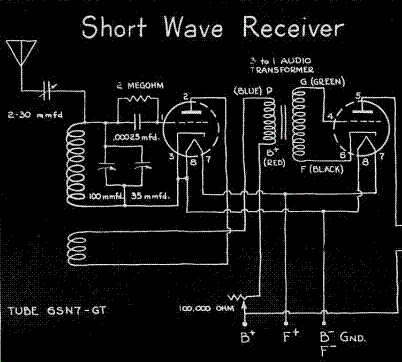
BLSept1950Schematic

Schematic from September 1950 Boys Life. Note correction in text.

The article was a bit short on construction details, and at least one of them was wrong. According to an editor’s note (by Pedro, of course) in the November issue (page 3), there should be a connection between pins 6 and 8 of the tube. And there are no operating details explaining how to get the radio to come to life. Interestingly, the regeneration control is identified as a “volume” control, with no instructions on how to operate it. I would have thought that the lack of details would have proved frustrating to many scouts who tried to make this receiver. But according to the Pedro’s November editor’s note, many of them noticed the error in the schematic. And the caption on the schematic indicates that “any good radio repairman or electrician can give you valuable assistance in assembling the materials.”

The circuit uses a single 6SN7 dual triode. One half is used as the regenerative detector, and the other half is used as an audio amplifier. The two stages are coupled with an audio transformer, and it provides enough output to drive a pair of headphones.  From the coil dimensions, I’m guessing that the receiver covered about 3-6 MHz.

The circuit is virtually identical to the one appearing in the 1950 handbook, which is available online at this link. It’s also very similar to the AA8V Twinplex Regenerative Receiver, with a couple of exceptions. The AA8V design uses a capacitor rather than a transformer to couple the two stages, and also includes a separate volume control, in addition to the regeneration control. AA8V uses a metal chassis, whereas both Boys Life and the Handbook mount the components on a board, with a metal front panel.  The Handbook version calls for a power supply of 180 volts.  The Boys Life version calls for a 45 volt B battery.  This could easily be supplied by five 9-volt batteries in series.  The Boys Life version runs the filament with a filament transformer, which the Scout can plug right in to the household current.  I’m guessing that the current version of the Guide to Safe Scouting would nix this idea, but four D cells in series should be adequate to supply the filament voltage.  The plate current for a receiver of this type is quite low, so the 9 volt batteries should last a long time.  If you use flashlight batteries for the filament voltage, you might go through those rather quickly.

Here’s a video of what appears to be the Handbook version in operation.  From its location in GI, it’s pulling in a DL calling CQ TEST in some contest.  In short, you can do quite a bit with one tube, even if you were a Boy Scout 63 years ago!

The parts should be easily obtainable.  You can get “new old stock” tubes at places such as Antique Electronic Supply.  In addition, the 6SN7 is one of the “audiophile” tubes still being manufactured in Russia and China.  This audio transformer should be close enough if you want to stick to the Boys Life/Handbook version.  Otherwise, you can go with the AA8V design, which seems to use only readily available components.


Book Review: Radio Science for the Radio Amateur by Eric Nichols, KL7AJ

At the Sooland Amateur Radio Association hamfest, I was the winner of $50 worth of ARRL books.  After perusing the available options, and deciding that my 2010 Handbook was current enough for my needs, I decided to get Radio Science for the Radio Amateur
by Eric Nichols, KL7AJ.

The book bears the rather steep list price of $27.95, although it’s available at Amazon for a bit less. Overall, it was a good read, although I think I would have been somewhat disappointed if I had paid the list price. I suspect the price had something to do with the handful of one-star reviews on Amazon.

Nichols is a regular poster on the forums at qrz.com, and the book’s writing style is a similar level of informality.  Some of the Amazon reviews point out that he seems to jump all over the place from topic to topic, and this is true.  However, the book isn’t intended to be a scientific treatise about any particular subject.  Nor does the book give many construction details.  What the book does do, and the scatterbrained style actually does well, is give the reader some ideas about real scientific experimentation that can be done by amateur radio operators.  It whets the appetite and lets the reader do some more research about what is possible.   The book doesn’t really teach you how to do anything, but it does teach you that a number of interesting activities can be done.

In no particular order, here are some of the insights that I got from the book:

1.  It’s possible to build a plasma chamber at home.  I’m not sure exactly what I would do with it once built, but he does suggest some ideas.

2. One can purchase data acquisition modules relatively inexpensively, and these allow you to interface a computer to an analog voltage source (such as a receiver S-meter, a photocell, or a thermocouple) so that the computer can easily collect data for later number crunching.

3. Amateur radio offers some real possibilities for distributed science. My own short story, Clint’s Best DX, concludes with an author’s note saying that the story was impossible. In the story, the hero discovers extraterrestrial life with his 6-meter beam. I explain that this is impossible, because the signal strength is just too weak for earthbound antennas.  (For an explanation of why, see this interesting NASA article, which also explains whether there are aliens watching reruns of I Love Lucy.)  The book got me re-thinking that conclusion.  If properly synchronized, it’s possible to distribute an antenna over widely separated points on earth.  If Clint were to use such a distributed antenna instead of his 6-meter Yagi, then perhaps he could listen to the farm reports from Canis Minor after all.

4.  Even the lone ham can do quite a bit of ionospheric research in his own back yard, and can probably do much more with some sort of distributed data collection.

The conspiracy buffs will be disappointed by this book, because it turns out that HAARP (the High Frequency Active Auroral Research Program) has a pretty mundane purpose, but makes use of some pretty interesting science.  It turns out that a lot of mixing of radio signals can take place in the ionosphere.  This is due to something called the “Luxembourg Effect”, which is explained pretty well in this 1935 article.  The powerful longwave transmitters of Radio Luxembourg (and Gorky, Russia) were found to cross-modulate the signals of stations on a higher frequency located further away along the same path.  The strong longwave signals were modulating the signal of the higher frequency station in the ionosphere as it passed over the longwave transmitter.

HAARP, as it turns out, was mostly involved in using this phenomenon as a cheap (by military standards) method of generating low-frequency signals.  It can be quite a task to generate a strong low frequency signal in order to communicate with submarines.  But if you want to generate a 20 kHz radio signal, one way to do it is to generate two HF signals 20 kHz apart.  The ionosphere will serve as the mixing stage, and the result is a 20 kHz signal being transmitted from the edge of space.  Since this signal penetrates sea water, the submarines can copy it.  Unfortunately for the conspiracy buffs, I can’t think of any easy way to use this phenomenon to generate earthquakes, hurricanes, or any of the other phenomena that are associated with HAARP in the minds of some.

I think the best use of this book is to inspire aspiring young mad scientists.  While not disclosing too many details, I think this book suggests a number of science projects that are well within the capabilities of a bright high school student.  So if you are a bright high school student looking for an interesting science fair project, I think you’ll get some good ideas from this book.  While your classmates are busy building their potato battery clocks or making a volcano out of vinegar and baking soda, you can be doing some actual science.  What do you think your teacher will find more interesting, a homemade model of a volcano, or your measurements of the motion of the ionosphere?  If you need to build some tangible device, then I suggest that a homemade plasma chamber, made out of a plexiglass tube, nails, and a pump from an old refrigerator, will probably be a bit more impressive than the potato clock that your classmate offers.

The price of the book is indeed a bit steep for the impoverished student.  If you can’t find a used copy on Amazon, you can speak to your friendly librarian and ask them to order a copy.  If your local library is also too impoverished to buy it, you’ll impress your local librarian to no end if you walk up to the reference desk and ask them to get a copy through “interlibrary loan”.  You simply print out the listing from WORLDCAT, which shows the closest library with a copy.  Your local librarian will request a copy from that library, and in a couple of weeks, it will be delivered for you to check out.  Librarians thrive on doing this sort of thing, and they will be absolutely thrilled to learn that a student actually knows what interlibrary loan is, and actually gives the librarian the excuse to engage in the process.

For now, I glossed over the chapters on Smith Charts and wave polarization.  There appears to be a lot of good material there, but it will require a bit more study than the quick read I was able to give most of the other chapters.  For once, however, I do have some understanding of what is meant by the “characteristic impedance” of a feedline.  A feedline is nothing more than in infinite number of tiny inductors in series, along with an infinite number of capactiors in parallel.  This tiny components have both an inductance and a capacitance.  And, of course, any time you have an inductance or capacitance, you also have an inductive reactance and capacitive reactance.   And when I re-read that chapter, I have no doubt that I’ll have some understanding of how those give the characteristic impedance of the feedline.

Perhaps I would have been a bit disappointed if I had shelled out $27.95 for the book.  But overall, I got some good ideas from the book and I’m pleased that I selected it as my hamfest door prize.