Author Archives: clem.law@usa.net

Review of Ripley’s Believe It Or Not Wisconsin Dells

We were recently passing through the Badger State on the way home from the Michigan QSO Party, and decided that the trip warranted a slight detour through Wisconsin Dells, one of the state’s most famous tourist destinations.   The main attraction is the scenic gorge along the Wisconsin River, but seemingly since time immemorial, the town has been the home to many tourist attractions.  These include destination-class water parks, but also a number of more kitschy “tourist traps.”  (And when we say tourist trap, we mean that in the kindest possible sense.  For example, we consider Wall Drug, a beloved national landmark, to also be a tourist trap.)

In my opinion, the best tourist trap in Wisconsin Dells is Ripley’s Believe It Or Not.  It is billed as an “Odditorium,” and features a myriad of artifacts of the odd or unusual.  I have to admit that I’ve always been a sucker for Ripley’s.  As a kid, we didn’t have the daily cartoon feature in our newspaper, but it was a well-known brand.  My family visited a similar museum in California, and Believe It Or Not books were readily available.  For example, I owned a copy of the 14th Series, shown here.  The egg shown on the cover illustrates the fact that if you hold an egg thusly (on the fingers, and not on the palm) and try to crush it with your fingers, it is impossible.

The preface of the book included a number of interesting facts about the number 14.  The one that sticks with me over the years was about the French surname “Quatorze.”  Like many surnames, this one represented an occupation.  And the original Monsieur Quatorze was a professional 14th guest.  If you were holding a dinner party and discovered to your horror that you had an unlucky 13 guests, you would just call Monsieur Quatorze, who would save the day.  It’s a good job if you can get it, believe it or not.  As a space filler, Ripley sometimes included unusual names found on grave stones, and this book contained the grave of Green Bean, found at the Bean family cemetery.

Now that we have the Internet, we can verify that there are two Green Bean graves, one of which is unmarked, although neither is located at the Bean family cemetery.

It had been at least ten years since I visited the Wisconsin Dells Ripley museum.  It appears that they’re constantly making changes, and it did appear to be completely different from what I had experienced before.  While the museum did cater to all ages, the modern version is probably more appropriate for young children than it previously was.  In the past, the focus was more on things that younger children might have found scary.  While they are still there (such as what is probably the most famous artifact, the shrunken head), they are not displayed quite as prominently.  Also, the main mode of getting to the lower level of the museum (where most exhibits are located) consists of slides.  There is also a stairway for older fans who don’t wish to slide.  While it is not prominent, there is apparently an elevator, so all of the museum, other than a couple of very small portions, are fully accessible to persons with disabilities.)  There’s also a ball pit tunnel, and guests are encouraged to touch all of the exhibits (unless they’re behind plexiglass, such as the shrunken head).  So even though adults will find the museum good for an hour or two of browsing, even young kids will have fun.

The museum isn’t particularly cheap.  The admission for adults over 10 years old is $29.11, and $21.83 for children 3-9.  Despite a valiant search on my part, there don’t appear to be any discounts or coupon codes.  (There are a couple of package deals to visit Ripley’s and other attractions owned by the same franchisee.)  But it’s still a good value, as those of all ages will find themselves entertained and educated for a couple of hours.

We, of course, scoured the museum looking for oddities relating to radio history.  Unfortunately, we are sad to report that we didn’t find any.  For that, you’ll need to keep following this blog.  I did learn one interesting fact, however, about one of the topics that sometimes discuss, namely, Scouting.  There was a life-size replica of the tallest human to ever live, Robert Wardlow.  What I didn’t know was that Wardlow was a Boy Scout, or to be specific, the tallest Boy Scout in history, since he was 7’4″ as a 13-year-old Scout.

If your travels take you to Wisconsin Dells, the Odditorium is worth a visit.  If, like us, you were just passing through the area on Interstate 90-94, it’s worth stopping for a couple of hours.  And if you are making the Dells a destination, it’s certainly worth including this attraction.


Amazon links on this site are affiliate links, meaning that this site earns a small commission if you make a purchase after using the link.

Emergency Communications for the Railroads, 1926

A hundred years ago, this railroad station agent was reviewing a message sent from another station via amateur radio. You need communications to run a radio–before sending a train down a westbound track, you better make sure that there’s not an eastbound train coming toward you. Normally, those orders go out via telegraph, but if the wires were down for any reason, that was a problem.

As late as the 1940s, you see occasional reports of amateur radio operators helping out the railroads with this vital traffic, such as during the 1949 Midwestern blizzard.  It is illustrated here on the cover of QST, May 1926. The accompanying article explains how the ARRL was approached by the Pennsylvania Railroad to set up a reliable backup system. Over the course of 10 weeks, tests were conducted to make sure there would be a smooth transition in case of emergency. All of the cities shown on the map below were represented, in most cases by multiple stations.


1956 Emergency Radio Receivers

Seventy years ago this month, the May 1956 issue of Popular Electronics showed these ideas for an emergency radio receiver. If the power was out, or the radio otherwise out of commission, the emergency adapter was simply placed near the loop antenna. Inductively coupled, it would use the set’s tuning circuit, and you could hear it through headphones. Three versions were shown. The cigar box version had the advantage of furnishing a place to store the headphones. Another one used a loop antenna from a broken radio, and the third variation had the coil taped permanently in place on the outside of the radio.


Family Preparedness, 1951

Seventy-five years ago, this scout, shown in the May 1951 issue of Boys Life, took the scout motto seriously. As a result, his family was prepared for just about anything.  The accompanying article asks “is your family ready,” and offers some pointers for family preparedness.  Here, it notes that a basement shelter can be mighty useful in an emergency.  The type of emergency isn’t specified, but they’re probably thinking of the A-bomb.

They are shown stocking it with food, battery radio, flashlight, alcohol stove, water, candles, blankets, simple furniture, and a few books.


Winding Your Own Transformers.

If you are in need of an unobtainium transformer, you can always just make your own! As the elementary student of electricity has learned, a transformer consists of nothing more than two coils of wire wound on a suitable core. In practice, it’s a bit more complicated than that, but not much more. The hardest part is probably coming up with a suitable core, but that is explained in the diagram at left.  The finished product is shown above.  If you need complete instructions, they were published 85 years ago in the April and May 1941 issues of the British magazine Practical Mechanics.

For a student looking for a unique science fair project, this series of articles will give many ideas.


1941 Phono Oscillator

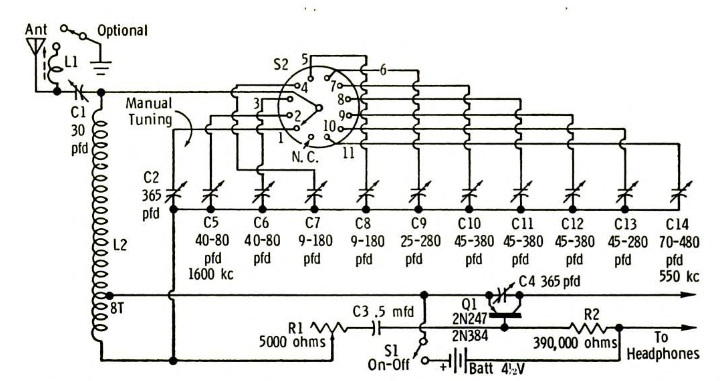
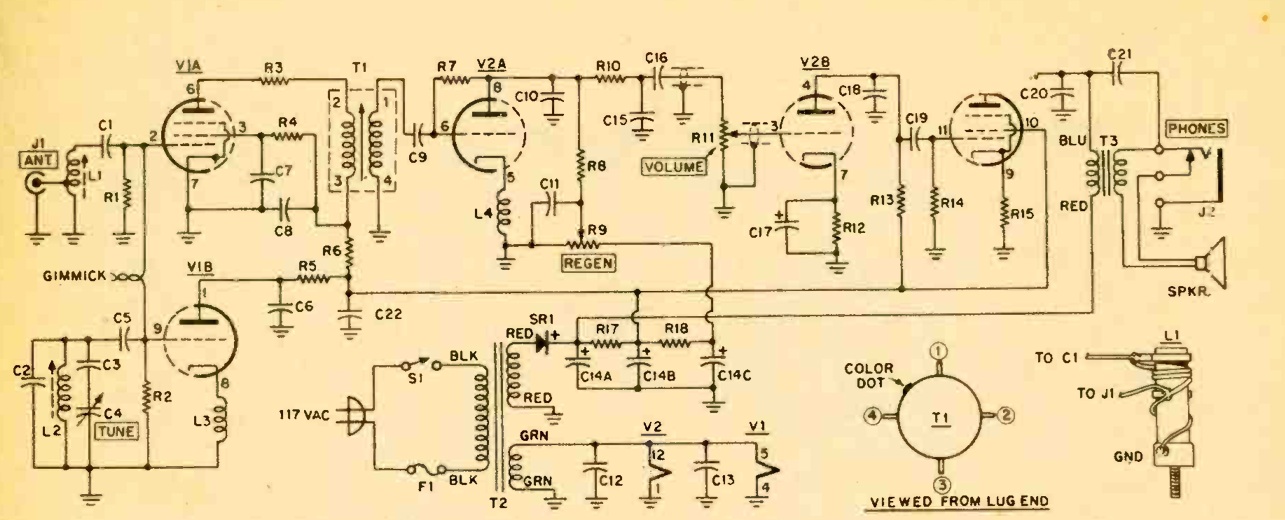
Eighty-five years ago this month, the May 1941 issue of Radio Craft carried this circuit for a simple phono oscillator. It had been sent in to the magazine by one Eugene Simpson of Naperville, IL, who pointed out that there had been a lot of interest recently in phono oscillators, and many enthusiasts were looking for a simple circuit. He recommended tuning the coil to the high end of the broadcast band, and cautioned not to use an antenna, as “The F.C.C. doesn’t like people who do otherwise!”


Michigan QSO Party

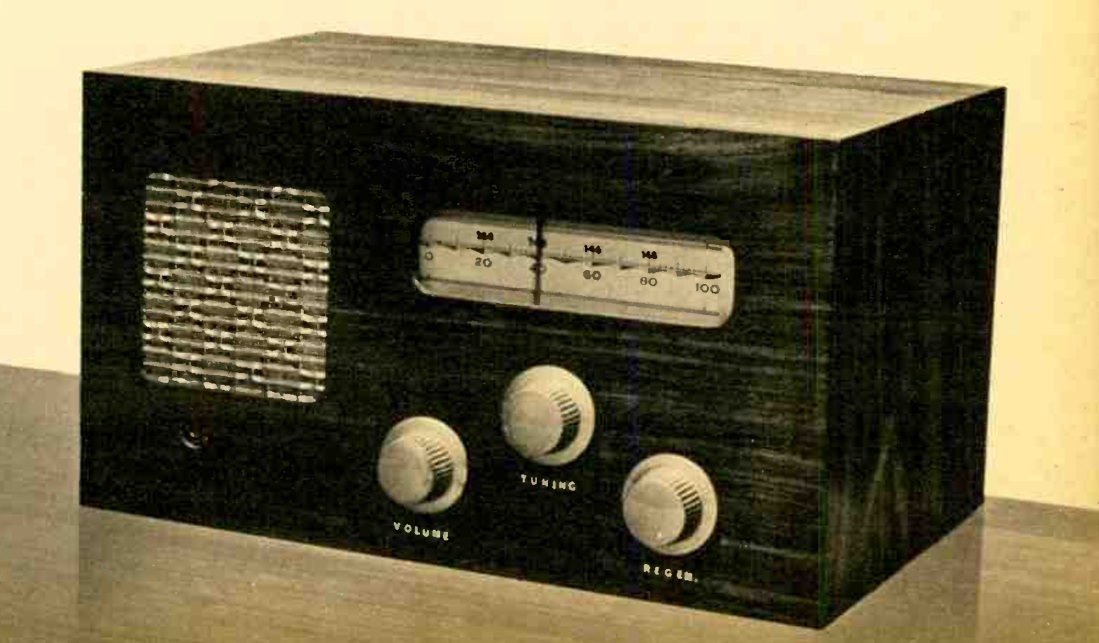
A couple of weekends ago, I operated the Michigan QSO party. I had originally planned to operate as a Rover in the Wisconsin QSO Party, but a late-season blizzard cancelled those plans. The original plan had been to start on Lake Michigan at the Wisconsin-Michigan border and work my way through the state’s northern tier of counties. Since that didn’t work out, I started at about the same spot, but instead activated the southern tier of counties of Michigan’s Upper Peninsula.

I started in Marinette County’s J.W. Wells State Park, where I did a POTA activation. The original plan was to set up a station on a picnic table. But the mid-April weather was still quite cold. After getting the dipole set up (using, of course, my trusty golf ball retriever , I didn’t fancy operating for an hour in the cold. So I operated instead from the mobile position in the back seat of the car, shown here.

Since most QSO’s were in motion and CW, I operated from this spot in the back seat, while my wife and daughter took turns driving.

I did activate another park, Bewabic State Park in Iron County. But instead of setting up the 40-meter dipole, I stayed on 20 meters an just used the Hamstick. Since I didn’t make it back to 40 meters after the first park, I had very few Michigan contacts, but I did manage to hand out some “rare” counties to other stations. My best DX was avid county hunter OM2VL in Slovakia.  I was QRP mobile, limited for most of the time to a single band, and didn’t plan on being a high scorer.  But I did manage just under 50 contacts in about 8 hours of operating, and had an enjoyable trip!!


some links on this site are affiliate links, meaning that this site earns a small commission if you make a purchase after using the link.

1941 Portables

Eighty-five years ago, this young woman is enjoying a favorite song from her portable phonograph. Hers was an electrical model, but there were many options for portable music, as detailed in the April 1941 issue of Radio Retailing.

The magazine noted that it was the perfect time of year to start marketing portables. Since April marked the beginning of the warm weather season, portables would get their greatest natural play. It also pointed out that since portables were still owned by relatively few people, they had a novelty factor that would help build store traffic.

Options included both radios and phonographs. While the unit shown above is electric, there were still many purely mechanical record players available, and the magazine provided an extensive directory of spring machines with no tubes. The least expensive was the Model 11 from Favorite Manufacturing Co., 105 E. 12th Street, New York, with a list price of $8.39.


1956 Custom Hi-Fi

Seventy years ago this month, this high fidelity enthusiast was making adjustments to the H. H. Scott control panel of a custom installation, put together by Custom Sound Systems of Orange, New Jersey.  The two lower drawers contained a De Jur tape recorder and Audiosphere stereophonic tape player.  The upper drawers contained a Rek-O-Kut record player and an Altec amplifier.

This deluxe setup is in the home of one Robert Ossorio of New York City.  But while this young woman appears at ease with the equipment, she’s actually a model, Mona McHenry, hired for the photo shoot.  The photographer is by Dan Rubin, and the photo appeared on the cover of the April 1956 issue of Radio-Electronics.


Getting the Antenna Higher: 1941

If you need to get the end of your antenna up a few more feet, you might try this idea sent into QST 85 years ago this month, April 1941. The idea is self-explanatory–you just hoist a new section of mast up your existing mast. The bottom of the new section contains a ring of heavy wire. The idea was submitted to Hints and Kinks by Bernard S. Shields, W5AJJ, who noted that if the guy wires are added to the top section, an appreciable height could be achieved.