
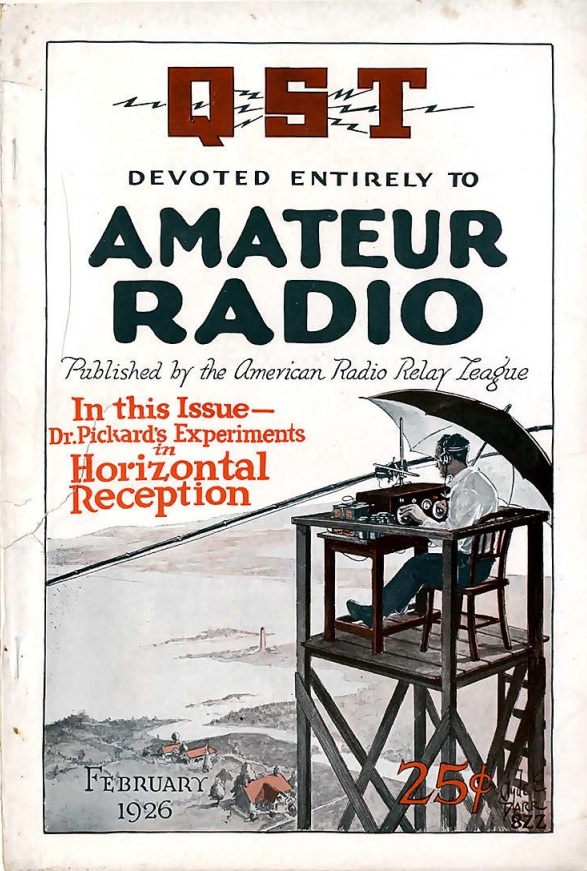
 The illustration on the cover of QST 100 years ago this month, February 1926, looks fanciful, but it’s a real scene. The accompanying article contains an actual photograph of the structure, used by Dr. Greenleaf W. Pickard (1877-1956) in carrying out experiments on what we would today call the polarization of radio waves.
Dr. Picard discovered that short waves, unlike long waves, do not remain vertical after leaving the transmitter. The structure was located at Seabrook Beach, NH, and analyzed waves of 80, 40, and 20 meters. Most of the stations received were calling CQ on the ham bands, and a number of schedules were also made. A total of 379 stations were logged to gather the data, including a few Canadian and European stations.
The article concluded by requesting readers to submit reports. It cautioned that a mere list of “calls heard” would be of little use. What was needed was comparisons of vertical vs. horizontal receiving antennas.