
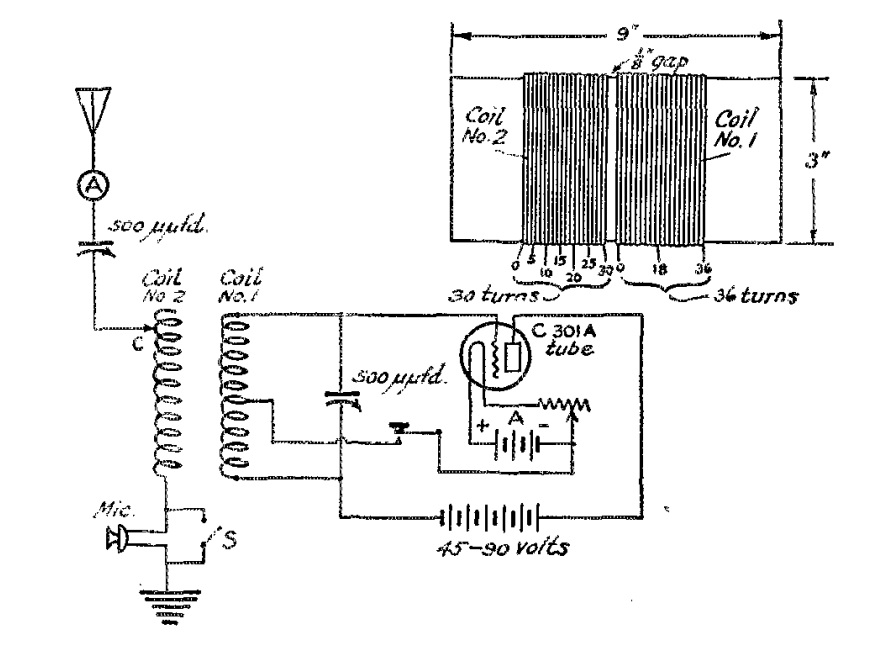
 One hundred years ago this month, the December 1925 issue of QST carried this circuit for “an inexpensive low power transmitter from receiving parts.” The author, Rufus P. Turner, 3LF, noted that many broadcast listeners, when they became interested in transmission, were put off by the high cost of transmitting apparatus. But he noted that this needn’t be an issue, since this low power CW and ‘phone transmitter could be built from receiving parts, including a C-301A or UV-201A tube, wired as a Hartley oscillator.
He noted that while some may view such a transmitter as a “worthless toy,” it was actually an effective low-power device. He reported that he had used it for three months, and worked many locals (in Washington, DC) on ‘phone, as well as many 2’s (New York) on CW, during daylight hours.
When the station was built, the next step was to obtain a license, which required submitting the proper form to the local Supervisor of Radio. Once that was out of the way, you were to call a local ham in your area and ask him to listen. “Hold down your key and speak into the microphone, using his station call and ‘signing’ your own.” When he heard you, you adjusted the coil and condenser until your signal was on about 170 meters (1.76 MHz).
The editor noted that phone operation was permitted only on 170-180 meters, whereas CW could be used on all other amateur bands. He noted that the circuit could easily be used on 80 meters. The editor also noted that he was “absolutely opposed to the use of the microphone in amateur transmission,” since “‘phone stations create enormously more interference than telegraphic stations. However, it is all right when using only a receiving tube and a 90-volt battery.”
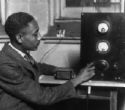 The name of the author, Rufus Turner, should sound familiar, as we previously featured him. He is believed to be the first African-American licensed radio amateur. He had no formal education in electronics, but nonetheless became a Professional Engineer in two states and was involved in the development of the 1N34 diode. He finally went to college in the 1950s, but earned degrees in English and became a Professor of English.