
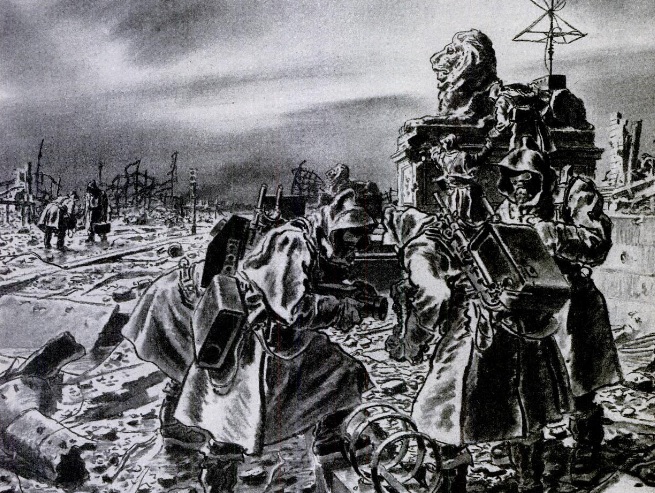
 Eighty years ago the Second World War was barely over, but the November 19, 1945, issue of Life Magazine was making predictions of what the next war might look like. The scene above shows the ruins of the New York Public Library, as technicians measure radioactivity levels.
Specifically, the magazine reviewed the findings of Army Air Forces General Henry H. Arnold in his report to the Secretary of War. It called it the “36-hour war,” and speculated that it would begin with atomic blasts in places like London, Paris, Moscow, or Washington. The speculated attack began with rocket-launching sites built secretly by some enemy in the jungle of equatorial Africa. In an hour, they would be on American soil, but American radar could give about 30 minutes of warning.
The defense would come in the form of a a counterattack, from firing tubes of American bases deep underground. This would deliver “an immensely devastating air-atomic attack” on the enemy.
Arnold speculated that the last phase of the attack on the U.S. would be in the form of airborne troops, armed with rockets to attack far distant points. But before they arrived, the U.S. could see 40 million fatalities.
“But as it is destroyed the U.S. is fighting back. The enemy airborne troops are wiped out. U.S. rockets lay waste the enemy’s cities. U.S. airborne troops successfully occupy his country. The U.S. wins the atomic war.”