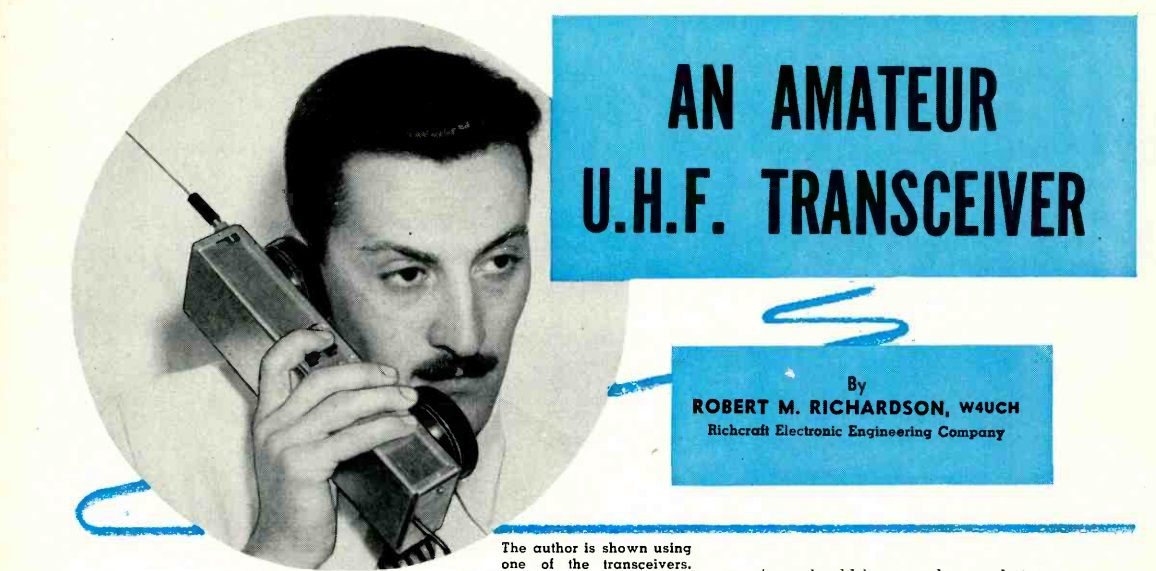
 Shown here, in the August 1955 issue of Radio News, is Robert Richardson, W4UCH, operating a 70 cm handheld radio. He noted that there was little activity above 2 meters, and set out to provide an economical way to get on the UHF band. The cost of each transceiver was only $13, meaning that two could be made for about $25. Range was about a mile over favorable terrain, with distances of up to five miles with an outside dipole antenna. The set was billed as ideal for short-range civil defense work.
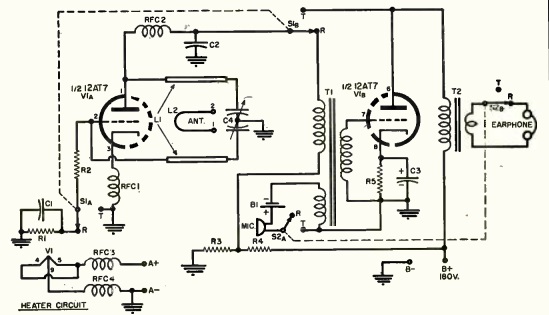
On transmit, half of the 12AT7 tube was used as modulator, with the other half as oscillator. On receive, the oscillator functioned as a self-quenching superregenerative receiver.
Tuning was accomplished with a temporary Lecher wire made of two wires nailed to a board. A knife or razor blade was moved along the wires until the receiver quieted. The distance between two such points was half the wavelength.