
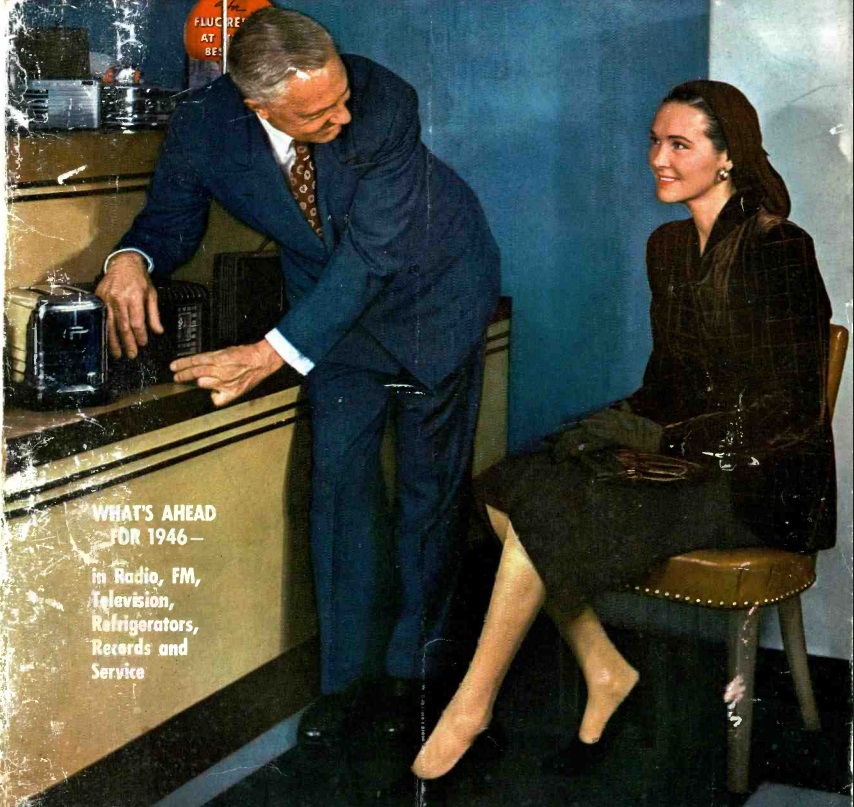
 Eighty years ago, this picture appeared on the cover of Radio Retailing, December 1945. I wasn’t quite sure what was going on, so I asked ChatGPT for the back story:
In the winter of 1946, the little shop on Westbury Avenue still smelled faintly of machine oil and warm dust—the scent of radios waking up after a long night. Mr. Harland, the shop’s proprietor, prided himself on being able to fix anything with a dial, but that morning he wasn’t repairing a set. He was demonstrating one.
“This one,” he said, patting the glossy black radio as though it were a fine horse, “has FM. Not many folks know it yet, but FM is the future. Clear as a bell—no static at all on a good day.”
Across from him sat a young woman in a tailored dark suit, gloves folded neatly in her lap. Her name was Margaret Hale. She had just returned from Washington, where she’d been decoding signals for the Navy. The war was over, but she hadn’t quite learned how to live quietly. She felt strange having nothing urgent to listen for.
Her aunt had suggested she buy a new radio. “Something cheerful,” the aunt had said, “to bring a bit of the world back into the house.” So Margaret found herself in Harland’s shop, watching the man beam with pride over the technology he’d been waiting years to see flourish.
He turned a dial, and warm music floated out—strings, a gentle swing rhythm, the kind of melody that wrapped itself around a person’s shoulders. Margaret smiled for the first time in weeks.
“It’s lovely,” she said.
“It is,” Harland agreed. “And next year—television. Mark my words. Pictures through the air. Folks’ll gather around these things like they once did around the piano.”
Margaret imagined it. Scenes unfolding in real time, stories arriving right into one’s home. She wondered what sort of world would rise now that the explosions had quieted. Maybe one with more voices, more connections, more ways to understand one another.
“I’ll take it,” she said.
Harland brightened even further. “Excellent choice. I’ll have it delivered this afternoon.”
As she stood to leave, she paused beside the radio. The music was still playing, light and hopeful. For the first time since the war ended, Margaret felt the faint stirrings of a life with room for ordinary joys—songs in the morning, news in the evening, perhaps even laughter filling the quiet corners of her home.
Outside, the cold wind of January 1946 swept past, but she felt warm. The world was humming again, and she was ready to listen.
I’m pretty sure that’s a toaster, and not an FM radio just to the left. But I can’t quite see what Mr. Harland is fiddling with, so it’s quite possible it’s an FM radio. But one way or another, the world was humming again.