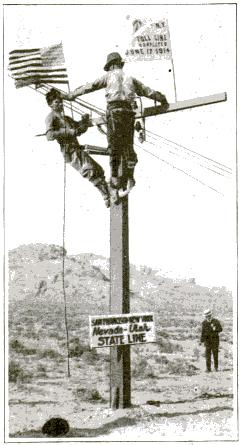
U.S. Army Signal Corps Field Buzzer. Technical Equipment of the Signal Corps: 1916.
A hundred years ago today (September 21, 1914), the Calumet (Mich.) News carried an article entitled, “Communication Big Factor in Modern War Machinery,” which explained the technological developments in communications in use in modern warfare. The article runs down the developments in telegraph, telephone, and wireless in use in the war.
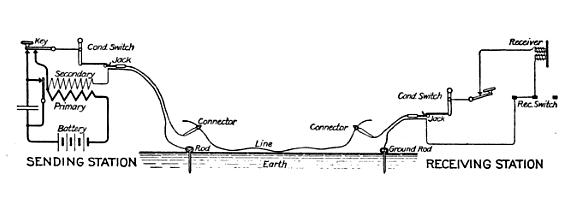
One that caught my attention was a rather ingenious telephone-telegraph that was used in situations where the lines were in poor shape. As the article points out, lines near the battlefield “are often laid at high speed, are of high resistance and are frequently leaky.” In those cases, it described a “special instrument known as the buzzer.”
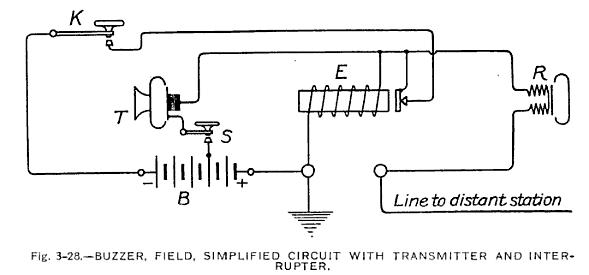
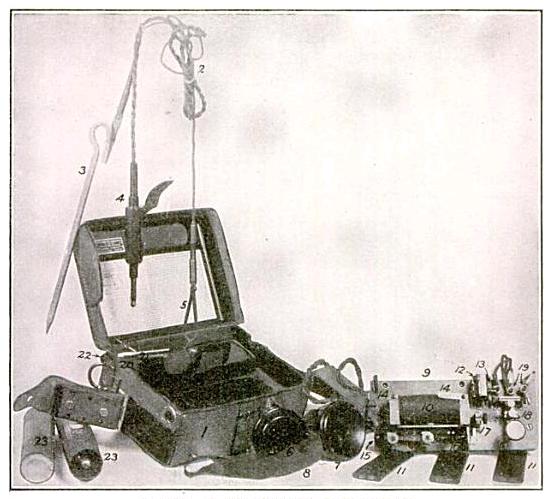
It describes the instrument as a metal-lined leather case with a dry battery, induction coil and interrupter, key, telephone transmitter, and telephone receiver. It could be used as a field telephone, or by use of the buzzer, the key could send out an intermittent current which would traverse the line where the distant receiver would give out a sharp note. Thus, the telephone could be used to send Morse code via audio.
It notes that these “Morse signals are audible over an incredibly bad line.” It cites one case where a signal was successfully sent over bare wires lying on wet ground.
The schematic of the instrument is shown here:
The field buzzer itself is shown above as it would be carried, and it is shown dismantled here:
This diagram of a typical hookup of the buzzer shows its use with a line of dubious quality:
References
Camp Telephone for the Army, Telegraph and Telephone Age, July 1, 1917, page 302.