Category Archives: Flashlight History

What To Do If Lost In The Woods At Night, 1946

Eveready1946

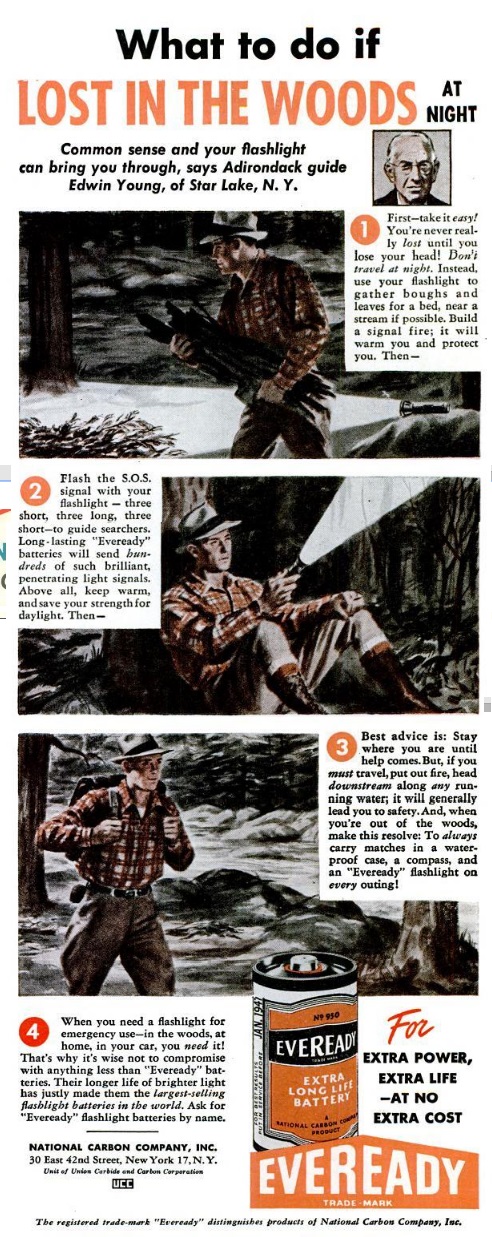
Seventy years ago, this day’s issue of Life Magazine, August 26, 1946, showed you exactly what to do if you were lost in the woods at night, courtesy of this advertisement by Eveready.

According to the ad, as long as you had common sense and an Eveready flashlight loaded with Eveready batteries, you would come through. The first piece of advice was that you’re never really lost until you lose your head. Therefore, the best course of action was not to travel at night. Instead, you should use your flashlight to gather boughs and leaves for a bed, and build a fire.

Once you made your primitive camp, the next course of action was to signal SOS with your flashlight–three short, three long, three short. This would guide searchers, especially if you had Eveready batteries, which would send hundreds of such brilliant penetrating light signals.

When morning came, the best bet was to stay put and wait for help to come. But if travel was necessary, you should douse your fire and follow any running water downstream.

In addition to the Eveready flashlight and batteries, the ad reminded that other survival necessities included matches in a waterproof case and a compass. These needs should be with you on every outing.

Click Here For Today’s Ripley’s Believe It Or Not Cartoon


1936 Battery Merchandising

1936BatteryDisplay

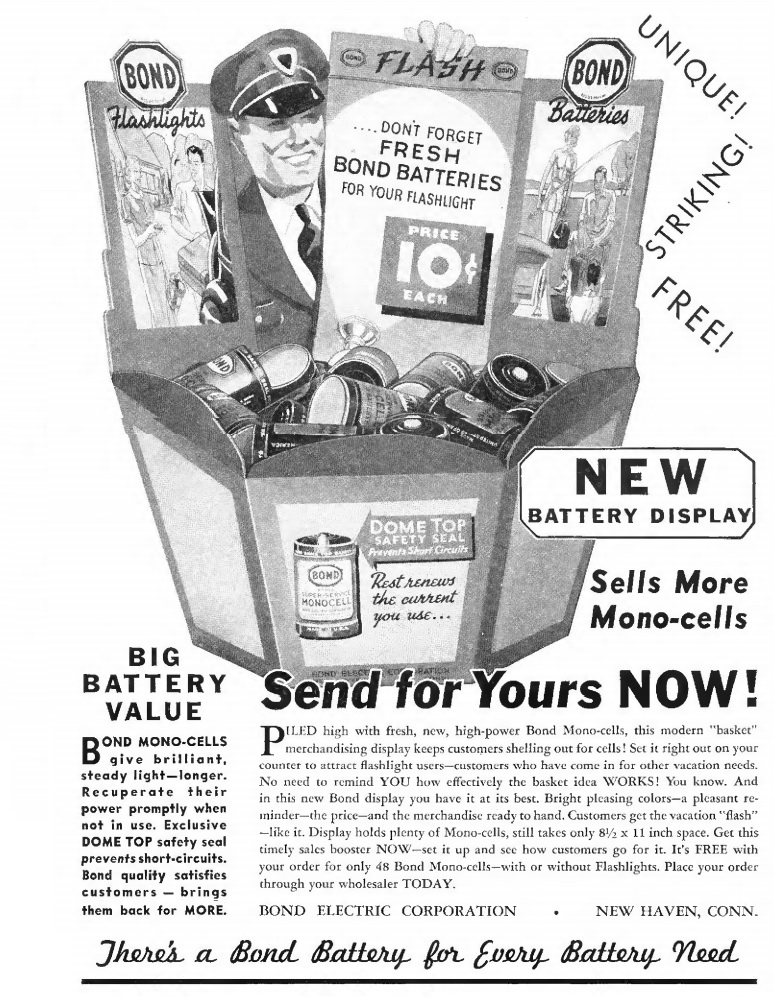
The radio retailer 80 years ago was always looking for a way to add a few more sales, and with summer vacation season underway, one idea was this counter top battery display for the obligatory flashlight.  The display took up only 8-1/2 by 11 inches of counter space, but promised to keep customers shelling out for cells.

The ad, from the Bond Electric Corporation of New Haven, CT, appeared in the July 1936 issue of Radio Retailing magazine.

Click Here For Today’s Ripley’s Believe It Or Not Cartoon

Building an online therapy practice


Another SOS by Flashlight, 1915

1915WirelessAgeSOS

The March 1915 issue of The Wireless Age carries the tale of the steamship Chester, a tanker owned by the American Petroleum Company. She had left New York on January 23 en route to Rotterdam with a cargo of oil. She ran into rough weather a few days out and suffered a tank bulkhead burst, but there was no immediate peril.

But on the afternoon of February 2, a giant wave swept over the vessel. The hatches were demolished and oil was pouring from the tanks. The engines were flooded and stopped; most of the contents of the deck, including the lifeboats were swept away; and the ship was listing so badly that the rails were in the water.

The ship was not equipped with wireless, but the second officer, Jacobus W. Waale, held a cargo grade wireless certificate and was familiar with Morse. With the one remaining signalling lamp and a flashlight, he began to signal SOS over the dark waves. All that night, no ship spotted the signal. The next day, signal flags were hoisted, also to no avail. When darkness once again fell, Waale once again resumed signalling with the lights.

Crew of the Chester aboard the Philadelphia after rescue.

Crew of the Chester aboard the Philadelphia after rescue.

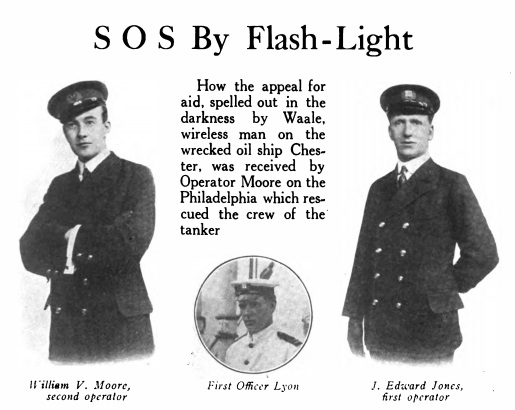
Fortunately, the steamer Philadelphia was making its way from Liverpool to New York. Normally, she would have been on a more southerly route, but had moved closer to the Chester’s position in an effort to avoid storms. A tiny spark of the Chester’s light was spotted from the deck of the Philadelphia, and the officers finally realized that a ship was trying to signal them. One of the officers had some knowledge of Morse Code and made out that it was an SOS. The captain instructed the wireless operator J. Edward Jones to establish contact with the signalling ship. This, of course, was in vain, since the Chester was not equipped with wireless. The ship’s second wireless operator, William V. Moore, was summoned to the deck to make contact with the signal light.

He flashed the message, “what is the matter?” It took almost thirty minutes to receive the reply, “we are a wreck.” The Philadelphia inquired as to whether the distressed ship had any boats, to which it received a negative reply. When asked “do you want to be taken off,” the Chester replied “yes.” The rescue was not easy, but it was facilitated by the use of the lights.

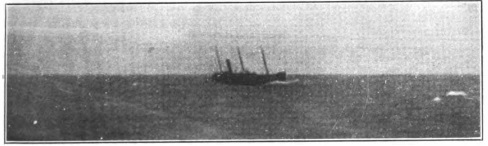
The Chester, as seen from the Philadelphia after the rescue.

The Chester, as seen from the Philadelphia after the rescue.

Interestingly, this incident came just a few months after another notable incident involving a flashlight used to send SOS from the Hanalei recounted in an earlier post.


Shipwreck of the Hanalei, 1914

Wireless operator Lovejoy signalling rescuers.

Wireless operator Lovejoy signalling rescuers.

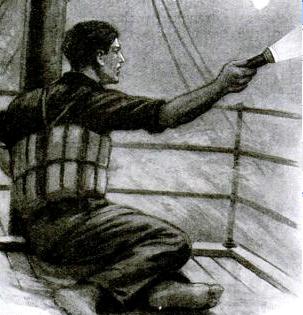
A hundred years ago this month, the February 1915 issue of Popular Mechanics reported the story of Loren A. Lovejoy, the wireless operator of the steamer Hanalei, shown here in this artist’s rendition.

The Hanalei suffered a shipwreck on November 23, 1914. While the incident is almost forgotten today, more than twenty of the 63 aboard the ship perished off Point Bolinas, 14 miles north of the Golden Gate. Even though the ship was within 500 feet of land and it was daylight when it hit the rocks, the rescue proved difficult. The ship initially made an incorrect report of its position. By the time rescuers realized the correct location, fog was setting in, and it was late at night before any rescue could be attempted. By then, the ship’s radio had been destroyed.  Trucks transporting the rescuers had to travel 60 miles on poor roads in heavy fog.

To communicate with the rescuers, Lovejoy was able to signal using Morse code with a flashlight. Those ashore were able to send “words of cheer” with automobile headlights. With a mortar, the rescuers would shoot a lifeline to the ship. Lovejoy then sent messages back such as “windward and too low. Send her higher.”

The Secretary of Commerce later sent a personal letter commending Lovejoy for “his courage and ingenuity, measuring up to the high standards of the wireless service.”

Lovejoy was born in Hillsdale, Kansas, on June 27, 1891, and graduated from high school in Seattle. He entered service with the Marconi Company in 1912.  He died in 1977.

The Seattle Star reported in the next day’s paper that Lovejoy was killed in the shipwreck. In fact, it was the Star’s reporter who communicated that sad news to Lovejoy’s father. The newspaper account, however, was greatly exagerated, and Lovejoy lived another six decades, Lovejoy survived the wreck. He is pictured in the 1960’s in White’s book linked below.  His First Grade operator’s license was listed as being renewed in December, 1916.

According to the Social Security Death Index, Lovejoy died in 1977 at the age of 86 in the Seattle area. He is buried at Acacia Memorial Park in King County, Washington.

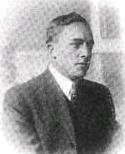
Adolph Svenson. Wireless Age, Jan. 1915.

Adolph Svenson. Wireless Age, Jan. 1915.

The Hanalei was originally constructed for the Hawaiian sugar trade, but was in service at the time of its wreck hauling lumber and passengers between Northern California and San Francisco.

The Hanalei’s assistant wireless operator, Adolph J. Svenson, who sent out the first SOS, was among those killed in the wreck.  He drowned when the ship broke up.  Lovejoy later recounted of his colleague, “throughout our terrible experience he remained cool and resourceful, upholding in an exemplary manner the traditions of the Marconi service.”  Svenson’s name is among those inscribed in the Wireless Operators Memorial in Battery Park, New York, which was dedicated on May 12, 1915.

References