
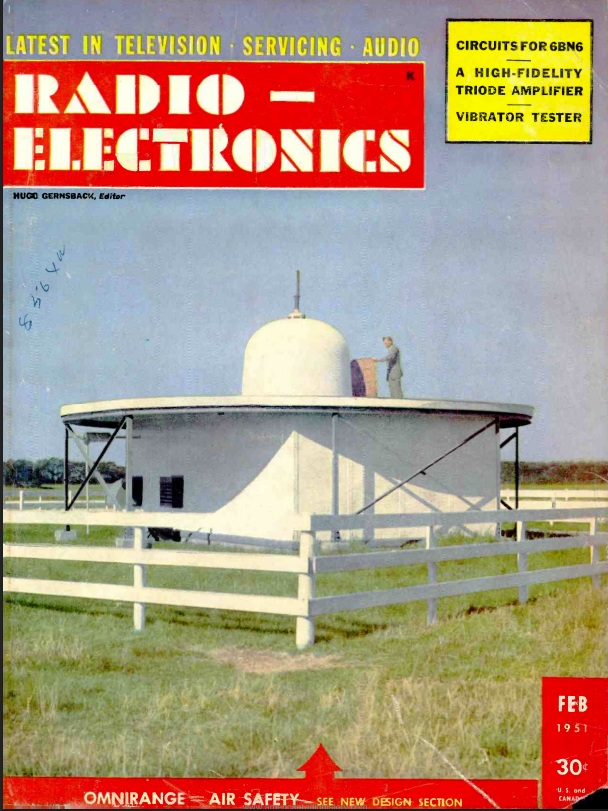
 Seventy-five years ago, the cover of the February 1951 issue of Radio Electronics shows what is recognizable to most pilots and radio enthusiasts as a VOR installation. Apparently, the name VOR (VHF Omni Range) hadn’t caught on yet, as the article uses the term “omnirange”. The Civil Aviation Administration had begun the process of installing them, and the price tag was estimated at a whopping $1.5 billion.
I’ve always thought the VOR was a very clever invention. It allows a pilot, armed with relatively simple passive equipment, to know the exact direction from the ground station. Unlike radio direction finding, there is no 180 degrees of ambiguity. You know right away the exact bearing to the station. This is accomplished by two signals from the VOR. There is an omnidirectional signal, as well as a directional beam that sweeps at a defined rate. By measuring the phase angle between the two incoming signals, the receiver instantly tells your bearing.
The particular station shown on the cover was at Erie, PA, and the photographer was Avery Slack.