
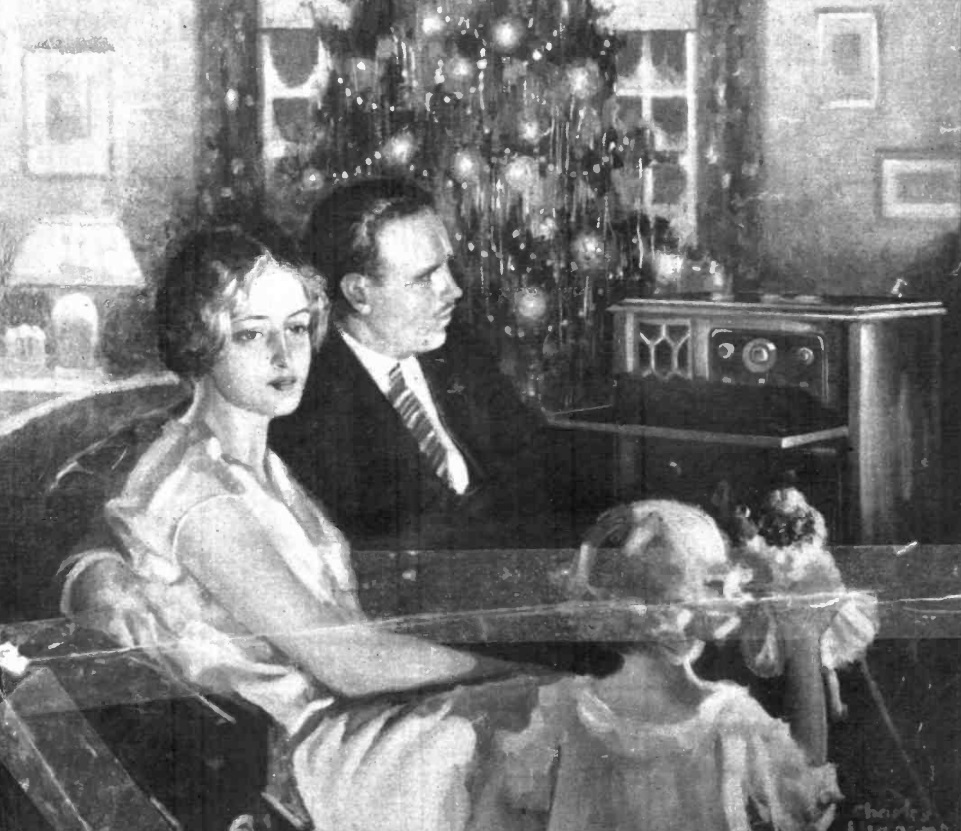
 One hundred years ago, this family is enjoying a program on their new radio. It was probably a Christmas present, and it was undoubtedly a factory set.
The picture appeared on the cover of Radio In The Home, December 1925, and the magazine carried a feature discussing the relative merits of homemade sets and factory sets. It noted that even five years prior, most radios were of the homemade variety, often wound on an oatmeal canister. But just as America had moved from homemade clothing to store-bought clothes in the prior century, it was decidedly moving toward factory sets. But while the transition in clothing might have taken a couple of generations, it was much faster with radio. While most sets were homemade just a few years earlier, the factory set was decidedly more popular in 1925.
The magazine did note, however:
Of course, there is still another class of home-made set builders besides the amateur and the radio wizard. This group consists of the men to whom a kit of tools and a mess of radio equipment is the finest recreation. It is a matter of almost complete indifference whether the finished set is better, or even quite as good as that which could be bought. The important thing is the pleasure obtained in the building. To such radio construction “fans” (they are really not amateurs because the building, not the experimenting, is the game) we all extend our best wishes, for theirs is both a wholesome and instructive avocation. Most of us, are, however, of another type.
We, that is you and I and our wives, most especially our wives, want a fine cabinet suitable for the living room. Dealers and manufacturers know this. Their displays at the radio shows this winter are centered around such fine cabinet sets.
This is probably true of most of our readers. A kit of tools and a mess of radio equipment is the finest recreation. But we still want that fine cabinet in the living room.