Monthly Archives: December 2025

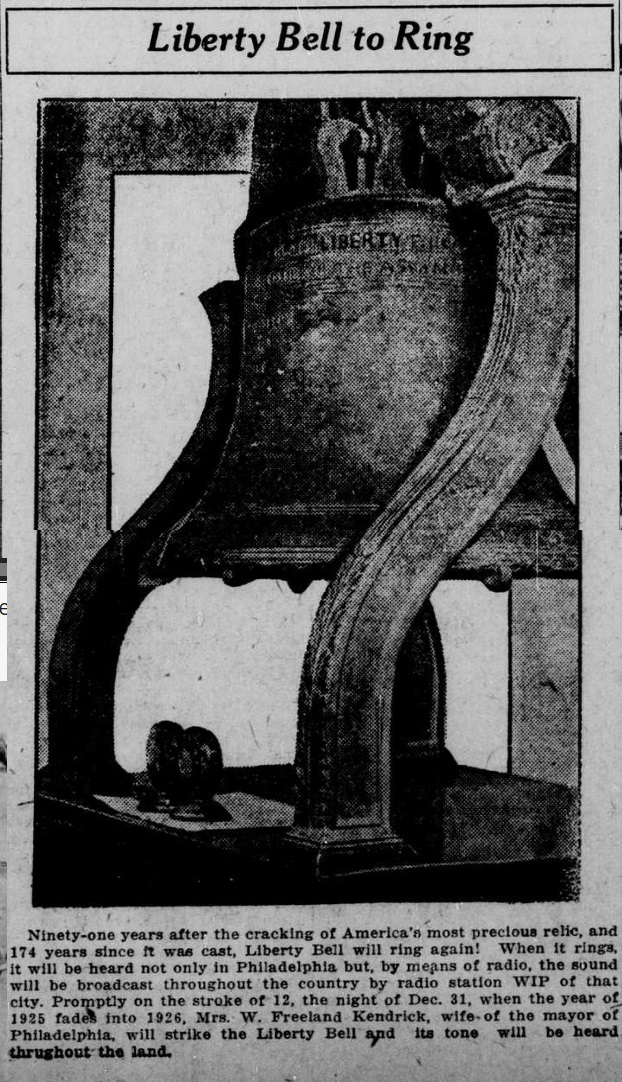
Liberty Bell By Radio, 1926

We previously reported how the Liberty Bell sounded in 1915, with the sound transmitted by telephone.  But to mark the start of the nation’s sesquicentennial year in 1926, it sounded again on January 1, 1926.  This time, the sound was transmitted by radio over station WIP.  This announcement appeared 100 years ago in the December 30, 1925, issue of the South Bend (IN) News-Times, and recounted how the wife of the Philadelphia Mayor, Mrs. W. Freeland Kendrick, was to have the honors of sounding the bell.

She actually tapped out 1-9-2-6 in Morse code, as detailed at this site.


1940 Three-Tube Radio

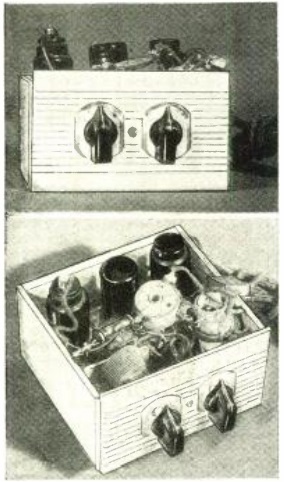
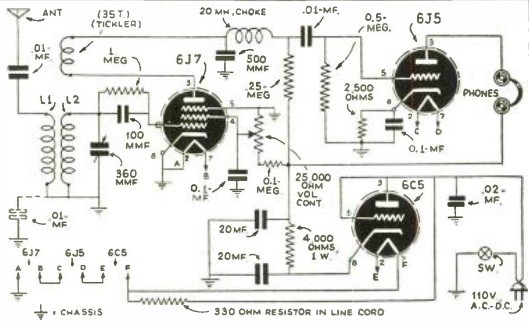
The December 1940 issue of Radio and Television Magazine showed how to put together this three-tube set for the broadcast band. A 6J7 served as regenerative detector, with a 6J5 audio amplifier. The 6C5 was pressed into service as rectifier, with a line-cord resistor dropping the filament voltage.

You’ll get some idea of the size by the fact that the front panel is made out of a standard household outlet cover. With a short antenna strung around a picture frame or on the floor behind furniture, the set would pull in local stations. Strong local stations might be strong enough to run a speaker.


1925 One Tube AM-CW Transmitter

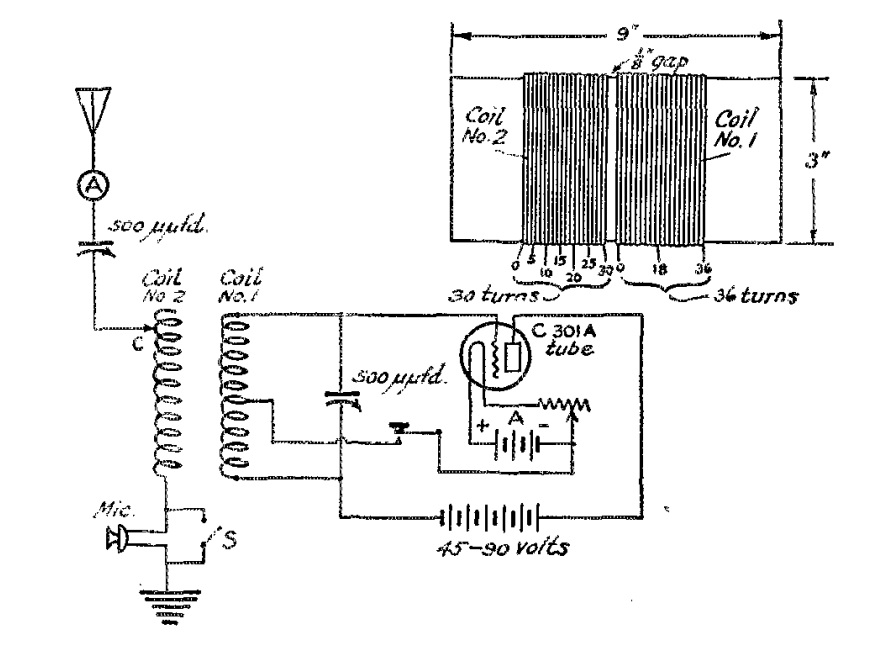
One hundred years ago this month, the December 1925 issue of QST carried this circuit for “an inexpensive low power transmitter from receiving parts.” The author, Rufus P. Turner, 3LF, noted that many broadcast listeners, when they became interested in transmission, were put off by the high cost of transmitting apparatus. But he noted that this needn’t be an issue, since this low power CW and ‘phone transmitter could be built from receiving parts, including a C-301A or UV-201A tube, wired as a Hartley oscillator.

He noted that while some may view such a transmitter as a “worthless toy,” it was actually an effective low-power device. He reported that he had used it for three months, and worked many locals (in Washington, DC) on ‘phone, as well as many 2’s (New York) on CW, during daylight hours.

When the station was built, the next step was to obtain a license, which required submitting the proper form to the local Supervisor of Radio. Once that was out of the way, you were to call a local ham in your area and ask him to listen. “Hold down your key and speak into the microphone, using his station call and ‘signing’ your own.” When he heard you, you adjusted the coil and condenser until your signal was on about 170 meters (1.76 MHz).

The editor noted that phone operation was permitted only on 170-180 meters, whereas CW could be used on all other amateur bands. He noted that the circuit could easily be used on 80 meters. The editor also noted that he was “absolutely opposed to the use of the microphone in amateur transmission,” since “‘phone stations create enormously more interference than telegraphic stations. However, it is all right when using only a receiving tube and a 90-volt battery.”
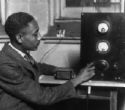
The name of the author, Rufus Turner, should sound familiar, as we previously featured him.  He is believed to be the first African-American licensed radio amateur. He had no formal education in electronics, but nonetheless became a Professional Engineer in two states and was involved in the development of the 1N34 diode. He finally went to college in the 1950s, but earned degrees in English and became a Professor of English.


Christmas Eve Radio, 1925

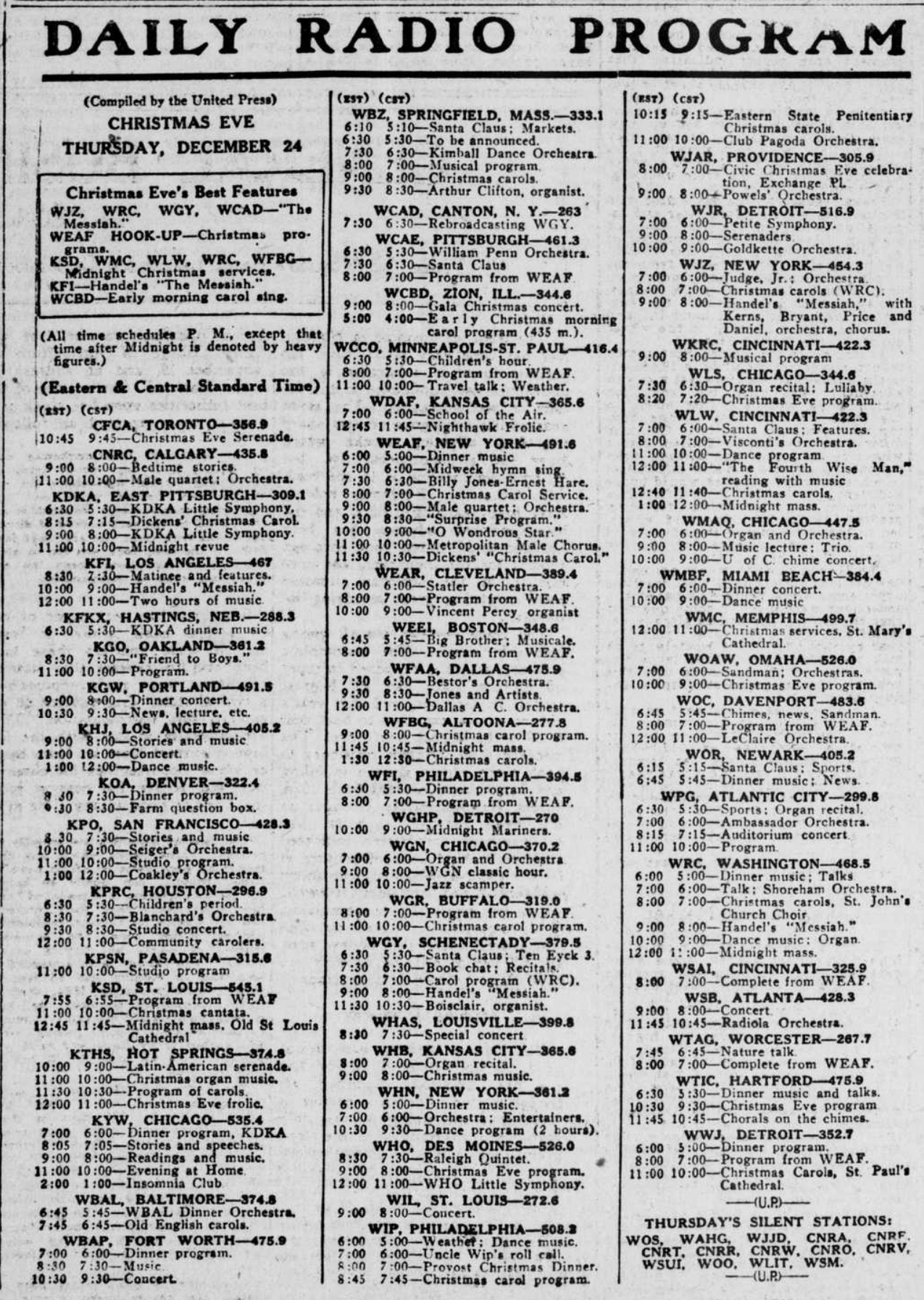
One hundred years ago, radio was definitely becoming a part of Christmas for many American families. Shown here is the program schedule for what Americans would be listening to on Christmas Eve. The network programming is most notable. Both WEAF and WJZ in New York were the flagships of growing networks. WEAF, which had the advantage of using AT&T lines, was the largest, extending as far west as St. Louis and Minneapolis. WJZ did not have that advantage, and managed with leased telegraph lines. This resulted in inferior sound quality, and a network extending only as far as Washington.

This schedule, compiled by the United Press, appeared in the December 24, 1925, issue of the Daily Kennebec Journal of Augusta, Maine.


1945 British Three Tube Receiver

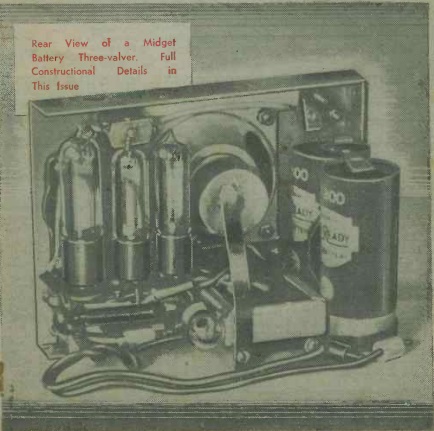
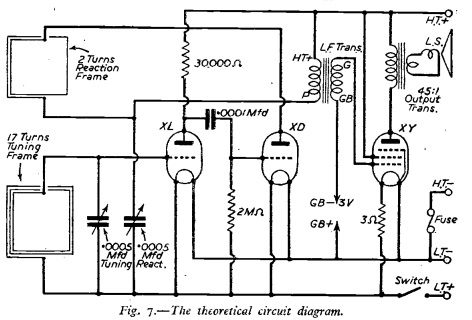
Eighty years ago, the construction details for this three-tube ultra midget receiver were found in the December 1945 issue of Practical Wireless.

The set was designed for size, and while it promised “reasonable reception” of the BBC Light and Home programs, the magazine made clear that “no exaggerated claims are made as to what may be expected.” The set, complete with batteries, measured only 5-3/4 x 4-3/8 x 2-3/4 inches, “so it can truly be claimed midget.” It was under two pounds, so “no one needs to grumble about carrying the set.” One space saving innovation was building a switch into the lid so that it opened whenever the lid was open.

The set had an internal frame aerial, but performance could be enhanced by tossing out few feet of wire.


Radio for Shoeshine Boy, 1940

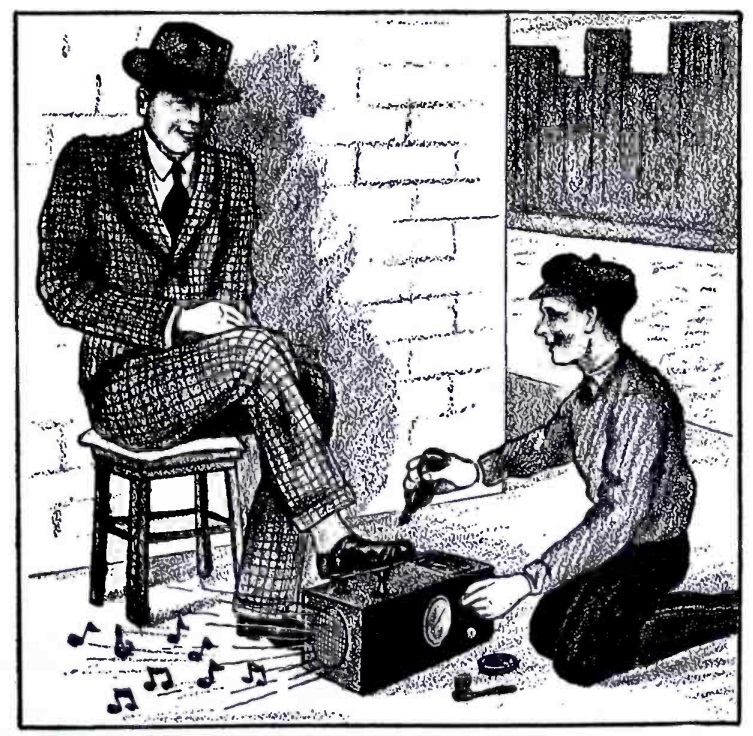
Eighty-five years ago this month, the December 1940 issue of Radio Craft showed the newest idea to come to its attention, namely, this shoeshine boy who installed a radio inside his shoe-blacking case.  He could thus entertain both himself and his customer with some radio entertainment.

No technical details are given, although they should be pretty self-explanatory.  Just about any circuit powered by batteries and with a loudspeaker would be suitable


1955 Hallicrafters SSB Station

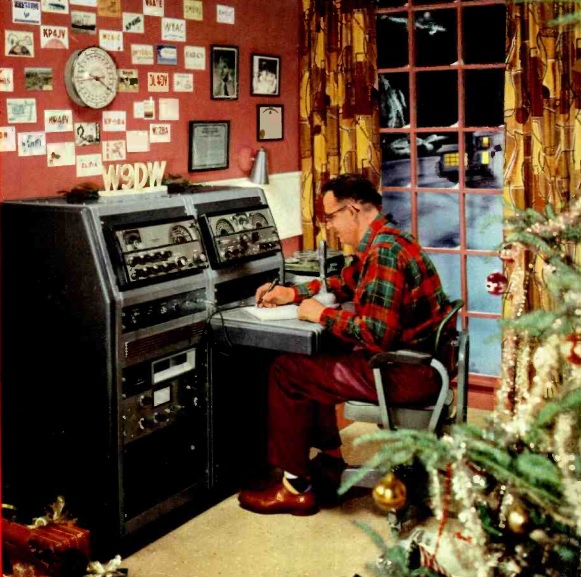
Shown here, all decked out for the holidays, on the cover of Radio News, December 1955, is the well equipped station of W9DW, who was undoubtedly a serious ‘phone man. The magazine contains technical details, courtesy of the Hallicrafters Company, of the commercially available single sideband (SSB) equipment which would soon change the ham bands.

The transmitter is a model HT-30, with 18 tubes (plus two rectifiers and one regulator). It starts out modulating a 50 kHz signal, which passes through three mixers to generate the desired frequencies. The receiver, while not identified in the article, appears to be an SX-100.


One Tube Radio Kit Under the Tree, 1955

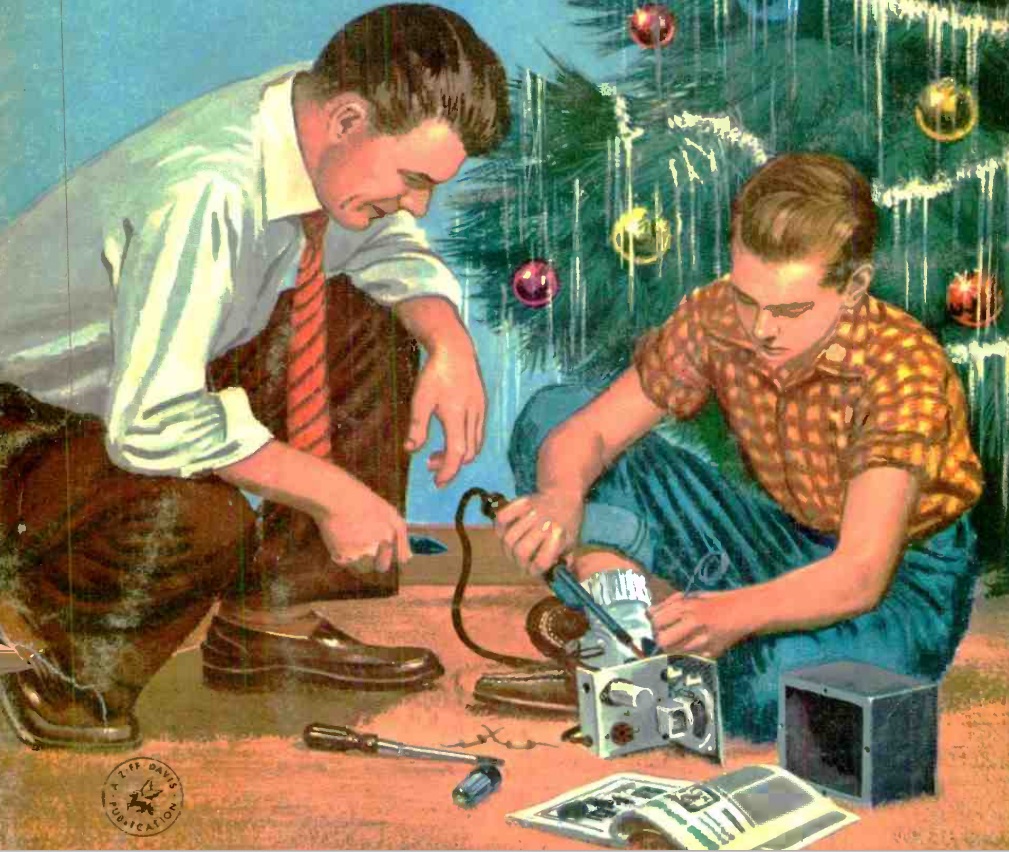
Seventy years ago, Santa Claus brought this young man an electronic kit, which looks like it could quite possibly be a one tube radio. Christmas morning, Dad encouraged him to do only logical thing–start putting it together right there under the tree. With Dad’s helpful guidance, we have no doubt that they were pulling in stations before Christmas dinner.

The illustration is by Ed Valigursky, whose work we’ve previously seen here and here.  It appeared on the cover of Popular Electronics, December 1955.


Western Electric 451A-1 Transmitter, 1945

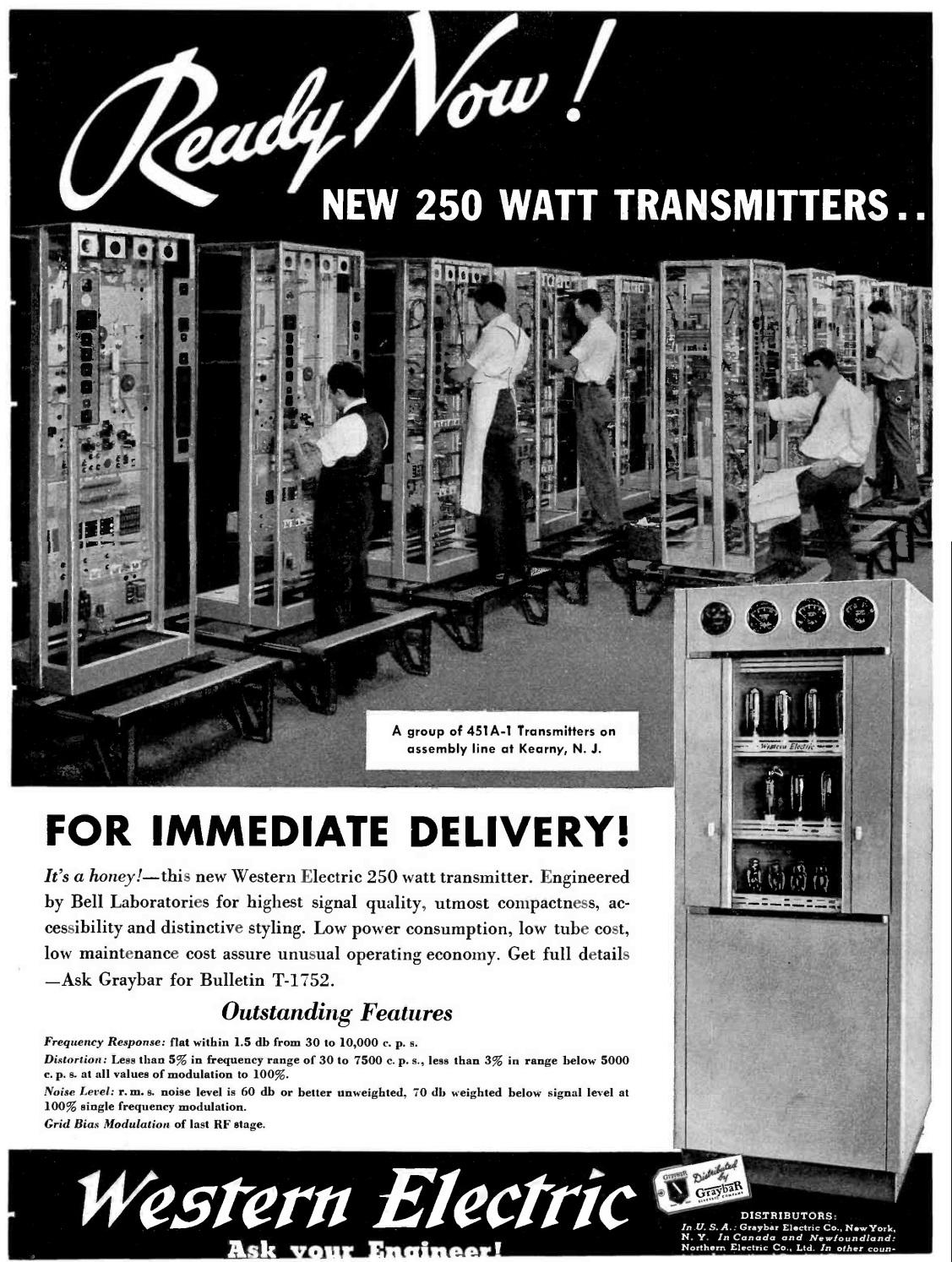
If you were a small broadcast station 80 years ago, you might be interested in knowing that you could purchase a Western Electric 451A-1 transmitter for immediate delivery. This ad appeared in the December 15, 1945, issue of Broadcasting. In addition to the broadcast band, it covered up as far as 2750 kHz, and ran from a single-phase 200-240 volt power supply, 50 or 60 Hz.

You can find the full specs and operating instructions at this link.


1925: A Factory Set or Homemade?

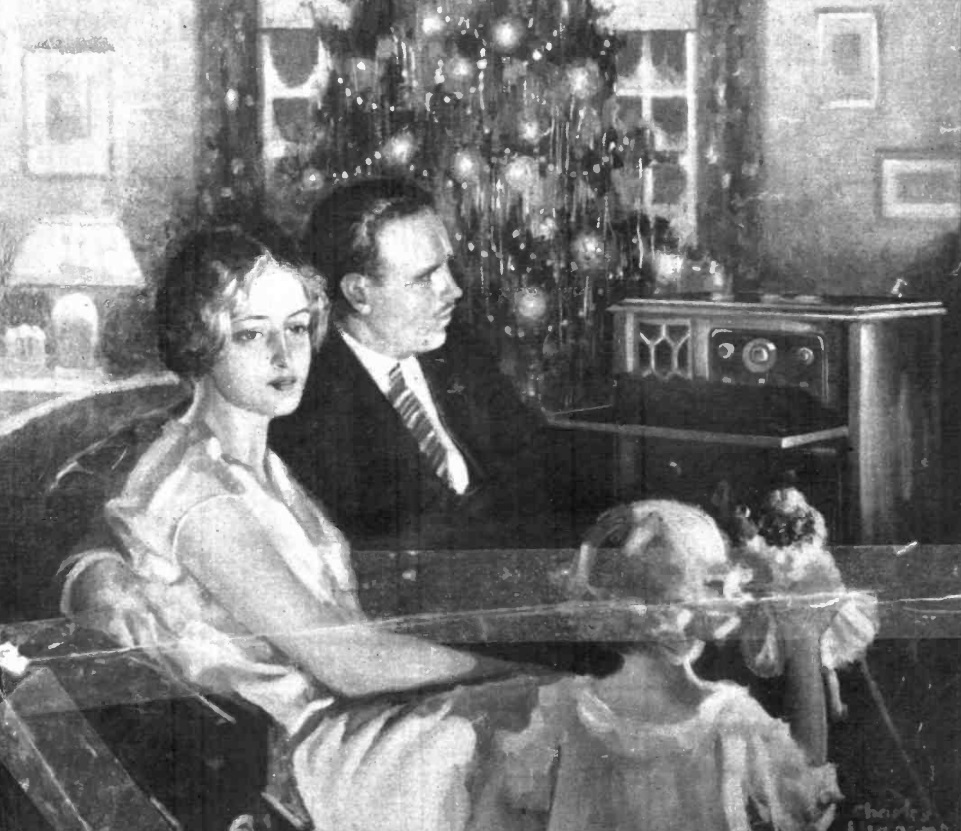
One hundred years ago, this family is enjoying a program on their new radio. It was probably a Christmas present, and it was undoubtedly a factory set.

The picture appeared on the cover of Radio In The Home, December 1925, and the magazine carried a feature discussing the relative merits of homemade sets and factory sets. It noted that even five years prior, most radios were of the homemade variety, often wound on an oatmeal canister. But just as America had moved from homemade clothing to store-bought clothes in the prior century, it was decidedly moving toward factory sets. But while the transition in clothing might have taken a couple of generations, it was much faster with radio. While most sets were homemade just a few years earlier, the factory set was decidedly more popular in 1925.

The magazine did note, however:

Of course, there is still another class of home-made set builders besides the amateur and the radio wizard. This group consists of the men to whom a kit of tools and a mess of radio equipment is the finest recreation. It is a matter of almost complete indifference whether the finished set is better, or even quite as good as that which could be bought. The important thing is the pleasure obtained in the building. To such radio construction “fans” (they are really not amateurs because the building, not the experimenting, is the game) we all extend our best wishes, for theirs is both a wholesome and instructive avocation. Most of us, are, however, of another type.

We, that is you and I and our wives, most especially our wives, want a fine cabinet suitable for the living room. Dealers and manufacturers know this. Their displays at the radio shows this winter are centered around such fine cabinet sets.

This is probably true of most of our readers. A kit of tools and a mess of radio equipment is the finest recreation. But we still want that fine cabinet in the living room.