
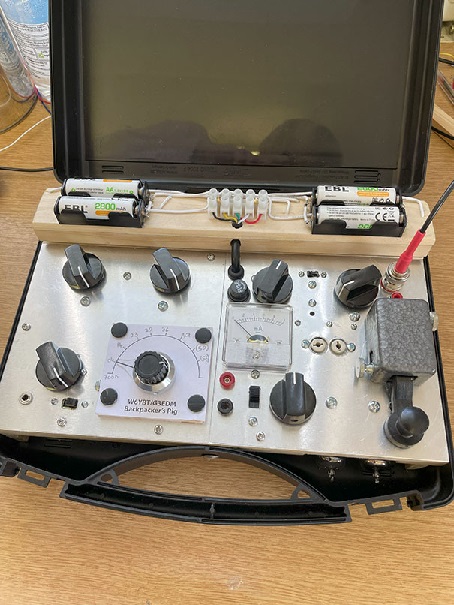
2025 G3EDM version. G3EDM photo.
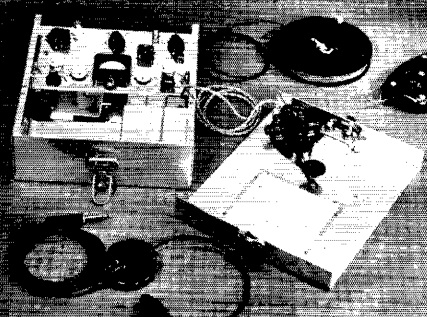
1950 W6YBT version.
Seventy-five years ago this month, the September 1950 issue of QST carried a construction article by Robert Vreeland, W6YBT, for the “Mountaineer”, a QRP transceiver designed by Vreeland for hiking treks in the California Sierras. He notes that while most hikers would argue against the added weight of even the smallest radio unit, hams were a different breed. Few hams would contemplate a vacation trek without bringing along some kind of radio gear, and the Mountaineer was his answer to the problem of how to explore nature while still staying on the air.
His design was for a single band, and he settled on 80 meters, although he recognized that 40 might be better for use during the day. When finished, his rig was useful for contacts of up to 20 miles during the day and 250 miles at night. The final design was a two-tube crystal controlled transmitter, with a 1U4 serving as oscillator and 3A4 amplifying with 2 watts input power.
The superheterodyne receiver consisted of three tubes, a 1R5 converter, 1U4 regenerative detector, and another 1U4 audio amplifier to drive the headphones. It shared the transmitter’s tank circuit as the input of the receiver and used a crystal-controlled local oscillator. Tuning was done in the detector, with each crystal covering about 120 kHz.
The rig’s enclosure provided space for extra tubes, fuses, and dial light. The author noted that since nights could be chilly, the set was usually operated from a sleeping bag, with an antenna of up to half wavelength.
The set measured 3x8x9 inches, and weighed in at 9 pounds, complete with batteries.
Unfortunately, we don’t have any photos of W6YBT operating his rig from a sleeping bag in the mountains, but we have even better! This year, 75 years after W6YBT first used the rig, Martin, G3EDM, was looking for a rig to take with him on a two-week 140 mile hike across England. And like W6YBT before him, going on vacation meant bringing along some kind of radio. According to an October 1993 article in 73 Magazine, W6YBT still just couldn’t leave ham radio at home, and eventually went solid state and got an MFJ-9020 QRP rig.
But G3EDM is our kind of person, and wanted to go “hollow state.” He eventually settled on the W6YBT design, with some modifications, and you can read his design notes at this thread on QRZ.com.
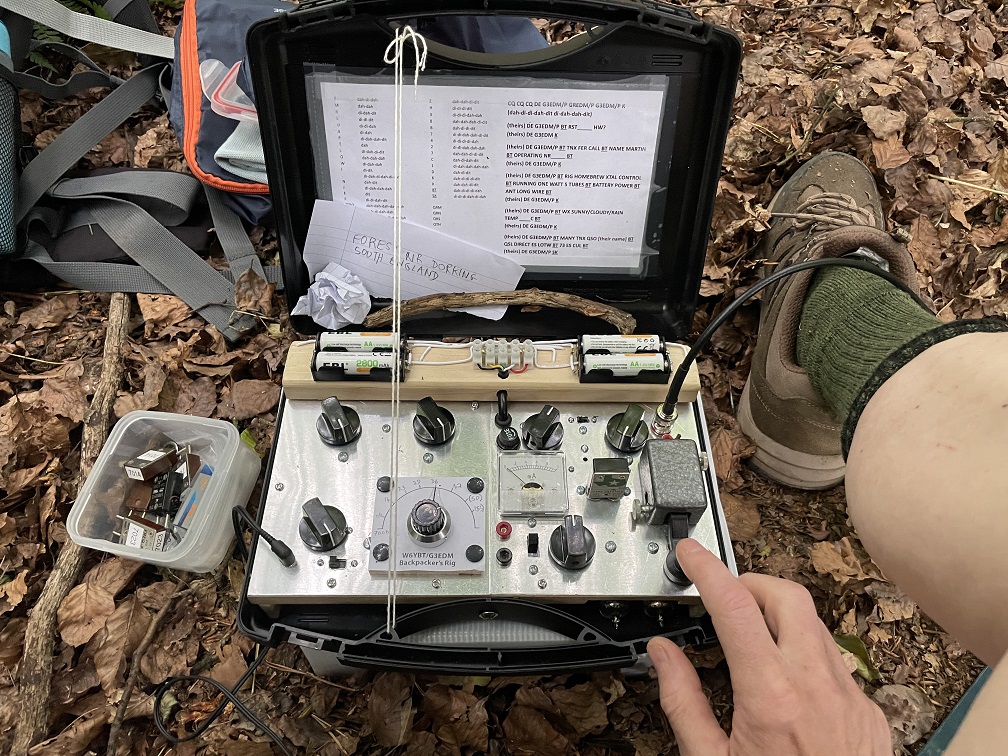
G3EDM at his operating position. G3EDM photo.
The color photo at the top of this page is not the 1950 version (for that we have only the grainy picture). It is actually the 2025 G3EDM version. There are some modifications. For example, the 2025 version is on 40 meters. Since most of the operating was to be done during the daylight hours, this was a better choice than 80. It also uses modern lithium batteries, which G3EDM was able to charge at night while lodging in hotels along his path.
He then outdid W6YBT (probably because we now have this internet thingie that makes it easy) by posting a detailed travelogue detailing his contacts at this thread.
He managed multiple contacts almost every day, usually set up outdoors, but sometimes from a hotel room. Most were to other stations in England, but he was spotted numerous times on the Reverse Beacon Network by stations in continental Europe. In fact, he copied a few stations in America who were trying to work him, and on a couple of occasions, his signal was heard across the Pond, although not strong enough for a complete QSO. The longest complete QSO was 430 miles to Scotland.
Martin’s complete travelogue thread is worth a read. Among other things, it does go to show that some of the old designs we feature here are not mere novelties–they really did work. 75 years ago, most people were unable to stay in touch with civilization while camped in the wilderness, but hams were able to. It’s just as amazing that the same feat can be replicated today, not just with the ubiquitous cell phone, but with that same 75-year-old technology.